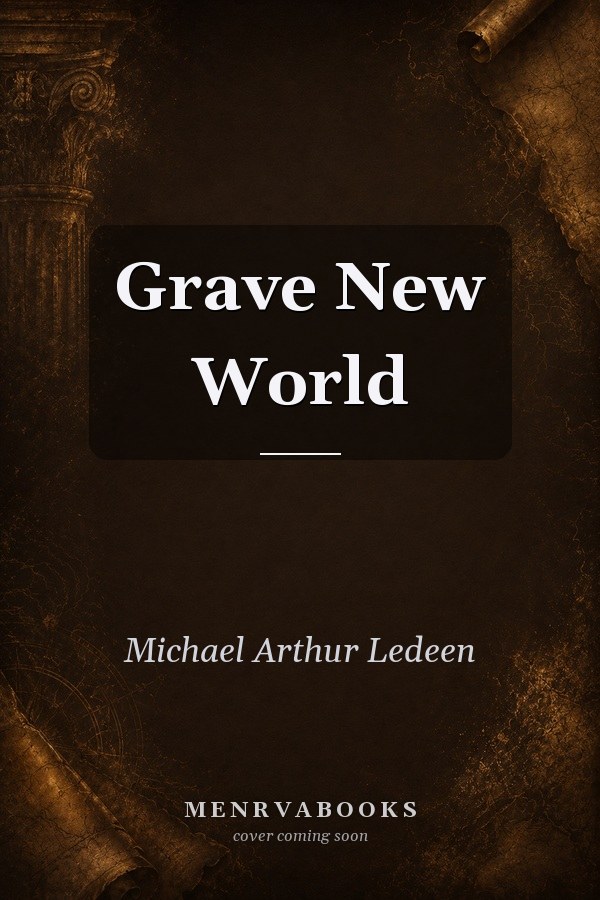
Grave New World
0
0
As an Amazon Associate and affiliate partner, Menrva Books earns from qualifying purchases. Learn more
Author Description
From Central America to Iran, from Poland to Lebanon, both the United States and the Soviet Union have in recent years shown a growing confusion and unpredictability. Michael A. Ledeen, drawing on his first-hand experience as a foriegn correspondent and Special Advisor to Secretary of State Alexander Haig, offers an original and challenging analysis of the current East-West crisis, explaining what went wrong and why."Instead of a direct confrontation between the two power blocs," Ledeen writes, "we now witness striking indecision on both sides." The failures of Soviet and American leadership, he contends, have encouraged leaders elsewhere--in Cuba and Israel, for example--to take risks and embark on international adventures they would never have attempted a decade ago, thereby increasing the risk of conflict between the superpowers. Ledeen looks at the reasons behind the super-powers' confusion and finds markedly different explanations in each case. The Soviet Union, he says, faces an internal structural crisis of potentially explosive magnitude, while the United States seems unable to produce a policy-making elite equal to the challenge of the modern world.As he isolates the specific factors in the increasingly dangerous world situation, Ledeen also considers "ways out" of the quandary, and suggests that the United States should pull together talent from throughout the Western world in its effort to construct sensible and durable approaches to foreign policy.
Menrva's Summary
THE THESIS
This work investigates the underlying causes of the perceived indecision and strategic confusion within the United States and the Soviet Union during the late Cold War era. Drawing on his professional background as a foreign correspondent and advisor to the U.S. Secretary of State, Michael A. Ledeen argues that the failure of leadership in both superpowers has created a power vacuum. This vacuum has emboldened regional actors to pursue risky international agendas, thereby destabilizing the global order and increasing the likelihood of direct superpower conflict.
THE SCOPE MAP
What You Will Find
- Analysis of the internal structural crisis facing the Soviet Union.
- Evaluation of the policy-making capabilities of the American political elite.
- Case studies of regional instability in Central America, Iran, Poland, and Lebanon.
- Proposed strategies for the United States to improve foreign policy through international collaboration.
THE AUTHORITY PERSPECTIVE
Experts recognize this text as a contemporary analysis of 1980s geopolitical tensions written from a specific policy-oriented viewpoint. Readers frequently note the author's focus on the intersection of domestic leadership failures and international security risks.
Page Count:
244
Publication Date:
1985-04-18
Publisher:
Oxford University Press
ISBN-10:
0195034910
ISBN-13:
9780195034912
History
Foreign Policy
United States
Cold War
International relations