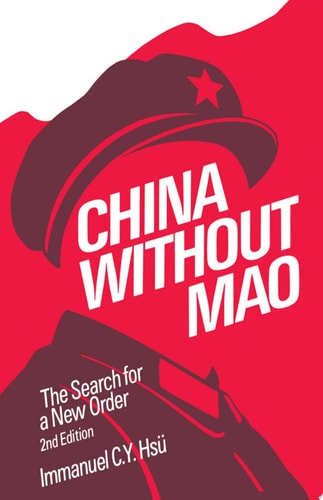
China without Mao
0
0
As an Amazon Associate and affiliate partner, Menrva Books earns from qualifying purchases. Learn more
Author Description
Now available in a new, updated edition, this groundbreaking book on post-Mao China, written by the distinguished Asian scholar Immanuel C.Y. Hsü, explores the astonishing transformation that has occurred there. Since Mao Zedong's death in 1976, China's leaders have launched an ambitious modernization program aimed at making their nation a relatively prosperous socialist state by the year 2000. Along with the first edition's examination of the smashing of the Gang of Four, the evolution of a new order under Deng Xiaoping, the manner and costs of modernization, the normalization of relations with the United States, and the prospects for reunification with Taiwan, the second edition offers an insider's view into China's policies of accelerated economic development and opening to the outside world, adopted at a December 1978 party conference. Focusing on the cultural impact of these policies, Hsü candidly reveals both the improved standard of living and the serious fundamental problems--including high inflation, widespread corruption, crises in leadership, loss of faith in communism, and especially the recent student protests--resulting from these recent developments. The new edition also includes a postscript which takes into account the causes and consequences of the Tian An Men Square massacre in June of 1989.
Menrva's Summary
THE THESIS
This book investigates the profound societal, economic, and political transformations in China following the death of Mao Zedong and the subsequent modernization efforts. Written by distinguished Asian scholar Immanuel C.Y. Hsü, this work examines China's ambitious modernization program initiated after 1976, aiming for a prosperous socialist state by the year 2000. It details the evolution of a new order under Deng Xiaoping, the costs and methods of modernization, the normalization of relations with the United States, and the prospects for Taiwan's reunification. The updated edition specifically addresses accelerated economic development, opening to the outside world, and the cultural impacts, including improved living standards alongside persistent problems like inflation, corruption, leadership crises, and declining faith in communism, culminating in the events of 1989.
THE SCOPE MAP
- Analysis of the post-Mao political landscape and the rise of Deng Xiaoping.
- Examination of China's modernization policies and their economic implications.
- Discussion of the cultural and social impacts of opening to the outside world.
- In-depth look at fundamental problems such as inflation, corruption, and ideological shifts.
- Coverage of the student protests and the Tiananmen Square massacre of 1989.
- Exploration of China's evolving relationship with the United States and the Taiwan issue.
THE AUTHORITY PERSPECTIVE
This book is regarded as a significant scholarly analysis of China's transition period. The updated edition provides a comprehensive overview of the dramatic changes occurring after Mao's death, incorporating events up to the Tiananmen Square massacre. It is noted for its candid assessment of both the progress made in modernization and the persistent, fundamental challenges faced by the nation. The work offers valuable insights into the complex interplay of economic reform, political stability, and social unrest in late 20th-century China.
Page Count:
352
Publication Date:
1990-03-22
Publisher:
Oxford University Press Academic US
ISBN-10:
0198022654
ISBN-13:
9780198022657
History
Politics
Non-Fiction
Asian Studies
Community Tags
Similar Books