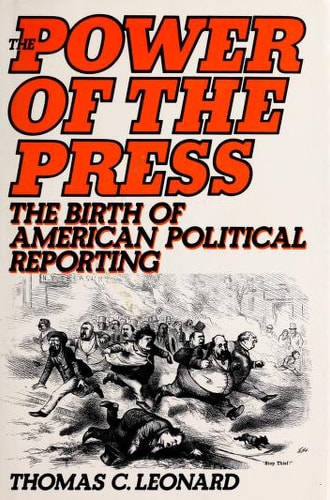
The Power of the Press: The Birth of American Political Reporting
0
0
As an Amazon Associate and affiliate partner, Menrva Books earns from qualifying purchases. Learn more
Author Description
Many books have shown that journalists have political power, but none have offered a more wide-ranging account of how they got it. The Power of the Press is a pioneering look at the birth of political journalism.Before the American Revolution, Thomas Leonard notes, the press in the colonies was a timid enterprise, poorly protected by law and shy of government. Newspapers helped make the Revolution, but they were not fully aware of the way they could fit into a democracy. It was only in the nineteenth century that journalists learned to tell the stories and supply the pictures that made politics a national preoccupation. Leonard traces the rise of political reporting through some fascinating corridors of American history: the exposes of the Revolutionary era, the "unfeeling accuracy" of Congressional reporting, the role of the New York Times and Harper's Weekly in attacking New York City's infamous Tweed Ring, and the emergence of "muckraking" at the beginning of our century.The increasing power of the press in the political arena has been a double-edged sword, Leonard argues. He shows that while political reporting nurtured the broad interest in politics that made democracy possible, this journalism became a threat to political participation.
Menrva's Summary
THE THESIS
This work investigates the historical evolution of political journalism and the mechanisms through which the press acquired its significant influence within American democracy. Thomas C. Leonard, a historian of media and politics, examines the transformation of the American press from a hesitant, colonial-era enterprise into a central pillar of national political discourse. By analyzing the shift from the Revolutionary period through the early twentieth century, Leonard argues that while journalism fostered essential public engagement, it simultaneously introduced complex challenges to the health of democratic participation.
THE SCOPE MAP
What You Will Find
- Historical analysis of the American press from the colonial era to the early 1900s.
- Examination of the transition from timid reporting to the emergence of investigative muckraking.
- Case studies including the Revolutionary era exposes and the campaign against the Tweed Ring.
- Evaluation of the dual impact of political reporting on public interest and democratic stability.
THE AUTHORITY PERSPECTIVE
Scholars and historians frequently cite this text as a foundational study for understanding the institutional development of the American media landscape. Readers often note the clarity of the historical narrative and the author's ability to connect specific journalistic milestones to broader shifts in political power.
Page Count:
278
Publication Date:
1986-03-20
Publisher:
Oxford University Press
ISBN-10:
0195037197
ISBN-13:
9780195037197
History
American History
Media Studies
Journalism history
Journalism
Community Tags
Similar Books