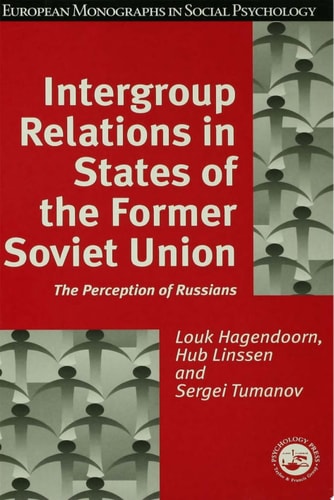
Intergroup Relations in States of the Former Soviet Union: The Perception of Russians
0
0
As an Amazon Associate and affiliate partner, Menrva Books earns from qualifying purchases. Learn more
Author Description
The disintegration of the Soviet Union in 1991 left 25 million Russians living outside the Russian Federation. This important new book explores their social identity, examining the mutually held perceptions, fears and resulting nationalism of both the ethnic Russians living outside the Russian Federation and the indigenous, or 'titular', populations they live amongst. Based on a unique study involving national surveys conducted in Belarus, Ukraine, Moldova, Georgia and Kazakhstan, the book maps the main individual, intergroup and cross-national factors that shape the fears of 'titulars' and Russians as well as the possible consequences and the risk of ethnic conflict in the five republics. There is detailed statistical analysis of how background factors (personal and national) affect intergroup perceptions; along with discussion of mutual stereotypes, social distance, language and the perception of citizenship and analysis of the dynamics of assimilation and separation of Russians in former soviet states. The attitudes of both groups to other smaller minority groups are also examined. This book provides significant new conclusions on the complexity of intergroup relations and seeks to relate these findings to a general theory of intergroup relations. It will be essential reading for those working in this area within the disciplines of Psychology, Sociology and Politics.
Menrva's Summary
THE THESIS
This book investigates the complex intergroup relations and mutual perceptions between ethnic Russians and indigenous populations in five former Soviet republics following the USSR's dissolution. It examines the social identity, fears, and nationalism of both groups, based on national surveys in Belarus, Ukraine, Moldova, Georgia, and Kazakhstan. The authors analyze individual, intergroup, and cross-national factors shaping these perceptions and the potential for ethnic conflict. The study also discusses mutual stereotypes, social distance, language, citizenship, and the dynamics of assimilation and separation.
THE SCOPE MAP
- Analysis of ethnic Russian populations living outside the Russian Federation after 1991.
- Examination of the perceptions, fears, and nationalism of both ethnic Russians and indigenous ('titular') populations.
- Detailed statistical analysis of factors affecting intergroup perceptions in Belarus, Ukraine, Moldova, Georgia, and Kazakhstan.
- Discussion of mutual stereotypes, social distance, language, and perception of citizenship.
- Analysis of the dynamics of assimilation and separation of Russians in former Soviet states.
- Examination of the attitudes of both groups towards smaller minority groups.
- Contribution to a general theory of intergroup relations.
THE AUTHORITY PERSPECTIVE
This book is presented as essential reading for specialists in Psychology, Sociology, and Politics, offering significant new conclusions on the complexity of intergroup relations. The research is based on unique national surveys and detailed statistical analysis, suggesting a rigorous and data-driven approach. Its findings are intended to contribute to a general theory of intergroup relations, indicating a scholarly and analytical focus. The work aims to map factors shaping fears and the risk of ethnic conflict in the studied republics.
Page Count:
288
Publication Date:
2013-05-13
Publisher:
Psychology Press
ISBN-10:
1134951868
ISBN-13:
9781134951864
History
Politics
Non-Fiction
Psychology
Sociology
Social Science
Community Tags
Similar Books