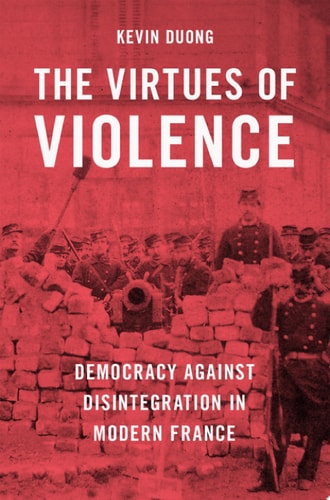
The Virtues of Violence: Democracy Against Disintegration in Modern France
0
0
As an Amazon Associate and affiliate partner, Menrva Books earns from qualifying purchases. Learn more
Author Description
If democracy liberates individuals from their inherited bonds, what can reunite them into a sovereign people? In The Virtues of Violence, Kevin Duong argues that one particular answer captivated modern French thinkers: popular violence as social regeneration. In this tradition of political theory, the people's violence was not a sign of anarchy or disorder. Instead, it manifested a redemptive power capable of binding and repairing a society on the cusp of social disintegration. This was not a fringe view of French democracy at the time, but central to its momentous development.Duong analyzes the recurring role of the people's redemptive violence across four historical moments: the French Revolution, the imperial conquest of Algeria, the Paris Commune, and the years leading up to World War I. Bringing together democratic theory and intellectual history, he reveals how political thinkers across the spectrum proclaimed that violence by the people could repair the social fabric, even as they experienced democratization as social disintegration. The path from an anarchic multitude to an organized democratic society required the virtuous expression of violence by the people--not its prohibition.Duong's book urges us to reject accounts that view redemptive violence as an antidemocratic pathology. It challenges the long-held view that popular violence is a sign of anarchy or disorder. As shocking and unsettling as redemptive violence could be, it appealed to thinkers across the spectrum, because it answered a fundamental dilemma of political modernity: how to replace the severed bonds of the old regime with a superior democratic social bond. The Virtues of Violence argues we do not properly understand modern democracy unless we can understand why popular redemptive violence could be invoked on its behalf.
Menrva's Summary
THE THESIS
How can a society reconcile the liberation of individuals from traditional bonds with the need to form a cohesive, sovereign democratic people? Kevin Duong, a scholar of political theory, investigates the historical paradox where modern French thinkers viewed popular violence not as a symptom of anarchy, but as a necessary mechanism for social regeneration. By examining key moments in French history, Duong argues that this redemptive violence was considered a foundational tool for repairing the social fabric during periods of intense political disintegration.
THE SCOPE MAP
What You Will Find
- Analysis of the French Revolution, the colonization of Algeria, the Paris Commune, and the pre-World War I era.
- A synthesis of democratic theory and intellectual history regarding the legitimacy of popular action.
- Examination of how political thinkers across the ideological spectrum justified violence as a means of creating democratic social bonds.
Scope Limits
- The text focuses specifically on the French intellectual tradition and does not provide a comparative analysis of redemptive violence in other Western democracies.
- The study does not offer a moral evaluation of the violence described, but rather an analytical account of its theoretical justification.
THE AUTHORITY PERSPECTIVE
Scholars of political history recognize this work as a rigorous examination of the often-overlooked relationship between democratic formation and state-sanctioned or popular violence. Readers frequently note the academic density of the prose, which is intended for those familiar with the nuances of modern political theory and French history.
Page Count:
262
Publication Date:
2020-04-16
Publisher:
Oxford University Press
ISBN-10:
0190058412
ISBN-13:
9780190058418
History
Politics
Social History
Political Theory
Violence in Society
French History
New Used & Rental Textbooks
Democracy
Educational Resources
History & Theory
Social Science
Politics & Government
Intellectual History
Geopolitics
Community Tags
Similar Books