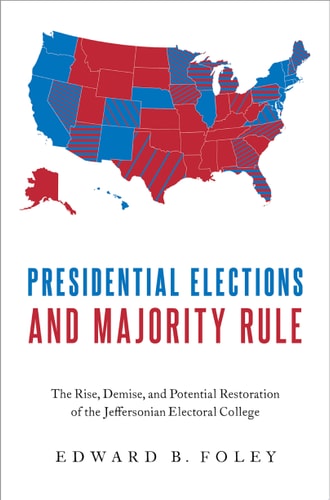
Presidential Elections and Majority Rule: The Rise, Demise, and Potential Restoration of the Jeffersonian Electoral College
0
0
As an Amazon Associate and affiliate partner, Menrva Books earns from qualifying purchases. Learn more
Author Description
A timely look into and argument for the Jeffersonian Electoral College.The Electoral College that governs America has been with us since 1804, when Thomas Jefferson's supporters redesigned it for his re-election. The Jeffersonians were motivated by the principle of majority rule. Gone were the days when a president would be elected by acclamation, as George Washington had been. Instead, given the emergence of intense two-party competition, the Jeffersonians wanted to make sure that the Electoral College awarded the presidency to the candidate of the majority, rather than minority, party. They also envisioned that a candidate would win by amassing a majority of Electoral College votes secured from states where the candidate's party was in the majority.For most of American history, this system has worked as intended, producing presidents who won Electoral College victories derived from state-based majorities. In the last quarter-century, however, there have been three significant aberrations from the Jeffersonian design: 1992, 2000, and 2016. In each of these years, the Electoral College victory depended on states where the winner received only a minority of votes.In this authoritative history of the American Electoral College system, Edward Foley analyzes the consequences of the unparalleled departure from the Jeffersonians' original intent-and delineates what we can do about it. He explains how states, by simply changing their Electoral College procedures, could restore the original Jeffersonian commitment to majority rule. There are various ways to do this, all of which comply with the Constitution. If only a few states had done so before 2016, the outcome might have been different. Doing so before future elections can prevent another victory that, contrary to the original Jeffersonian intent, a majority of voters did not want.
Menrva's Summary
THE THESIS
How can the American Electoral College be reformed to align with the original Jeffersonian principle of majority rule? Edward B. Foley, a professor of law and director of the election law program at Ohio State University, examines the historical evolution of the Electoral College from its 1804 redesign to the present day. He argues that recent electoral outcomes, where winners secured victory despite failing to win majorities in their winning states, represent a departure from the system's intended function and proposes constitutional state-level procedural changes to restore its original purpose.
THE SCOPE MAP
What You Will Find
- Historical analysis of the 1804 Jeffersonian redesign of the Electoral College.
- Examination of electoral outcomes in 1992, 2000, and 2016 as systemic aberrations.
- Proposed procedural reforms for states to ensure presidential candidates secure majority support.
Scope Limits
- The text does not advocate for the total abolition of the Electoral College.
- It does not focus on the popular vote as a replacement for the current state-based system.
THE AUTHORITY PERSPECTIVE
Experts and political observers recognize this work as a significant contribution to the debate on electoral reform, noting its focus on constitutional compliance. Readers frequently highlight the clarity of Foley's historical research and the practicality of his proposed state-level solutions.
Page Count:
256
Publication Date:
2020-01-02
Publisher:
Oxford University Press
ISBN-10:
0190060158
ISBN-13:
9780190060152
History
Politics
West Indies
Americas
General
Social Science
Systems Theory
Legal History
New Used & Rental Textbooks
Politics & Government
Government
Professional Career & Trade
Elections
Constitutional Law
United States
Social History
Elections & Political Process
American History
Law
Comparative
Community Tags
Other Editions(2)

Similar Books




Reader Comments
Share Your Thoughts
No comments yet. Be the first to share your thoughts!