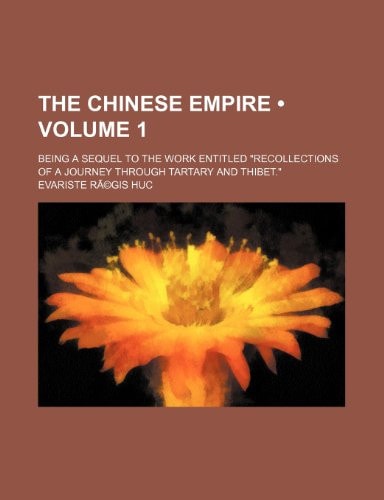
The Chinese Empire Volume 1: Being a Sequel to the Work Entitled Recollections of a Journey Through Tartary and Thibet
0
0
As an Amazon Associate and affiliate partner, Menrva Books earns from qualifying purchases. Learn more
Author Description
This historic book may have numerous typos and missing text. Purchasers can download a free scanned copy of the original book (without typos) from the publisher. Not indexed. Not illustrated. 1855 Excerpt:... THE NAMES OF CHINA AND CHINESE. 345 CHAP. IX. NAMES GIVEN BT THE CHINESE TO THE KINGDOMS OP EUROPE.--ORIGIN OF THE WORDS CHINA AND THE CHINESE. EXPLANATION OF THE VARIOUS NAMES THAT THE CHINESE GIVE TO THEIR EMPIRE.--GOOD AND VENERABLE PREFECT OF SONG-TCHE-HIEN. PORTRAIT OF THE ANCIENT MANDARINS. HOLY INSTRUCTIONS OF THE EMPERORS. A KHORASSANIAN OF THE IMPERIAL COURT. DETAILS CONCERNING THE MANNERS OF THE ANCIENT CHINESE.--CAUSES OF THE DECAY OF THE CHINESE. MEANS EMPLOYED BY THE MANTCHOO DYNASTY TO CONSOLIDATE ITS POWER FOREIGNERS NOT ALWAYS EXCLUDED FROM CHINA.--BAD POLICY OF THE GOVERNMENT. GENERAL PRESENTIMENT OF A REVOLUTION. NAVIGATION ON THE BLUE RIVER.--TEMPEST. LOSS OF PROVISIONS. RUNNING AGROUND THREE TIMES SHIPWRECK. THE SHIPWRECKED. The young prefect, of I-tou-hien, after having gathered with liveliest interest all the information we could give him concerning the different countries of Europe, bethought himself to ask us how we called his country in our language. When he heard that we gave it the name of China, and its inhabitants that of Chinese, he could hardly recover from his astonishment. He insisted upon knowing what these words meant, the sense attached to them, why the words China and Chinese should have been chosen to designate his country and his countrymen. " We," said he, " call the happy inhabitants of your illustrious country Si-yang-jin; now Si means West, yang sea, and jin man, so that the word means 'Men of the Western Seas that is the general denomination. To designate the several nations, we transcribe their names as faithfully as our characters will allow of. Thus we say Fou-lang-sai, that is to say homme-faran-cais. When we speak of the Westerns we sometimes seize on a striking trait of the people whom we wish to point out....
Menrva's Summary
THE THESIS
This work investigates the origins and meanings of the names 'China' and 'Chinese,' exploring the historical context and perceptions of the Chinese Empire and its people. The author, Evariste R. Huc, a known traveler and writer on Asian subjects, presents a sequel to his previous work, drawing on historical accounts and personal observations. The book delves into the various names the Chinese use for their own empire, contrasts them with foreign designations, and examines the characteristics and policies of ancient Chinese mandarins and dynasties. It also touches upon the societal decay, the consolidation of power by the Manchu Dynasty, and the complex relationship between China and foreigners, all while recounting a perilous journey on the Blue River.
THE SCOPE MAP
- Exploration of the etymology and historical usage of the terms 'China' and 'Chinese'.
- Analysis of the names Chinese people used to refer to their own empire and kingdoms.
- Portraits and descriptions of ancient Chinese mandarins and their governance.
- Discussion of the policies and methods employed by the Manchu Dynasty to maintain power.
- Examination of the causes of perceived decay within Chinese society.
- Insights into the historical interactions between China and foreign nations.
- Narrative of a challenging navigation and shipwreck experience on the Blue River.
THE AUTHORITY PERSPECTIVE
This historical text, originally published in 1855, offers a detailed examination of the nomenclature surrounding China and its people, alongside broader historical and societal observations. The provided excerpt suggests a scholarly approach, blending linguistic analysis with historical narrative and personal anecdote, characteristic of 19th-century travelogues and historical accounts. The book appears to be aimed at readers interested in the history, culture, and political landscape of China during a significant period of dynastic transition and foreign interaction. Its focus on the origins of names and the intricacies of governance points to a readership seeking in-depth understanding of historical contexts.
Page Count:
118
Publication Date:
2012-02-12
Publisher:
General Books LLC
ISBN-10:
1235674681
ISBN-13:
9781235674686
Non-Fiction
History
China
Ancient China
Community Tags
Similar Books

Reader Comments
Share Your Thoughts
No comments yet. Be the first to share your thoughts!