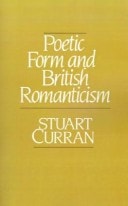
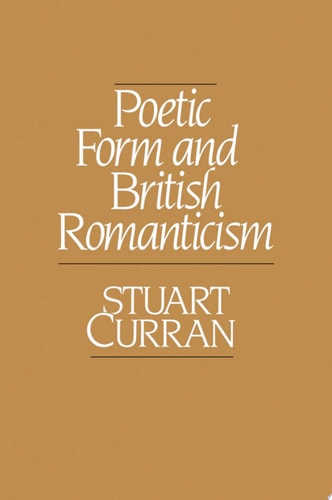
Poetic Form and British Romanticism
0
0
As an Amazon Associate and affiliate partner, Menrva Books earns from qualifying purchases. Learn more
Author Description
Across Europe, and particularly in Great Britain, the Romantic age coincided with a large-scale revival of lost literatures and the first attempts to create a coherent history of Western literature. Ranging with assurance across that history, Stuart Curran demonstrates that Romanticism, far from being indifferent or hostile to the received forms of literature as popular caricature has held, was actually obsessed with them as repositories of literary conventions and conveyors of implicit logical of ideological value. Whether in their employment of fixed forms, which resulted in the incomparable artistry of Romantic odes, or in their rethinking of major genres like the pastoral, the epic, and the romance that gave the movement its name, the Romantic poets transformed every element they touched to accord with a democratic, secular and skeptical ethos, a world view recognizably modern in its dimensions.
Menrva's Summary
THE THESIS
This work investigates the relationship between the formal structures of poetry and the ideological shifts inherent in the British Romantic movement. Stuart Curran, a distinguished scholar of Romantic literature, challenges the prevailing notion that Romantic poets rejected traditional literary forms. Instead, he argues that these writers engaged deeply with established genres—such as the ode, the pastoral, and the epic—to articulate a modern, secular, and democratic worldview.
THE SCOPE MAP
What You Will Find
- A comprehensive analysis of the revival of historical literary forms during the Romantic period.
- Examination of major genres including the pastoral, the epic, and the romance.
- Scholarly exploration of how fixed poetic forms were adapted to convey new ideological values.
- A historical framework connecting Romantic artistry to the development of Western literary history.
THE AUTHORITY PERSPECTIVE
Scholars and students of Romanticism frequently cite this text as a foundational study for understanding the technical and formal innovations of the era. Experts highlight the author's ability to synthesize complex literary history into a coherent argument regarding the modernity of Romantic poetic practice.
Page Count:
276
Publication Date:
1986-08-07
Publisher:
Oxford University Press
ISBN-10:
0195040198
ISBN-13:
9780195040197
Poetry
Poetics
Literary Criticism
British literature
English poetry
Romanticism
Community Tags
Other Editions(7)



Similar Books

Reader Comments
Share Your Thoughts
No comments yet. Be the first to share your thoughts!