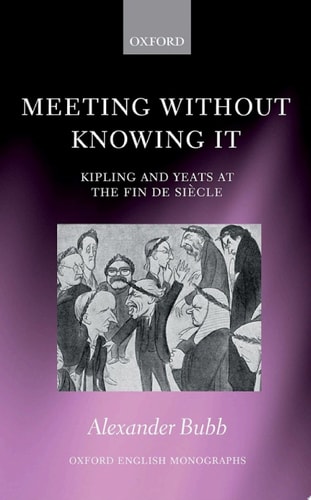
Meeting Without Knowing It: Kipling and Yeats at the Fin de Siècle
0
0
As an Amazon Associate and affiliate partner, Menrva Books earns from qualifying purchases. Learn more
Author Description
Meeting Without Knowing It compares Rudyard Kipling and W.B. Yeats in the formative phase of their careers, from their births in 1865 up to 1903. The argument consists of parallel readings wed to a biographic structure. Reading the two poets in parallel often yields remarkable discursive echoes. For example, both men were similarly preoccupied with the visual arts, with heroism, with folklore, balladry and the demotic voice. Both struck vatic postures, and made bids for public authority premised on an appeal to what they considered the 'mythopoeic' impulse in fin de siècle culture. My methodology consists in identifying these mutual echoes in their poetry and political rhetoric, before charting them against intersections in their lives. Kipling and Yeats were, for much of their careers, irreconcilable political enemies. However, a cross-reading of the two poets' bardic ambitions, heroic tropes and interpretations of history reveals that, to achieve their opposed political ends, they frequently partook of a common discourse. Supplementing this analysis with biographical context, we can trace these shared concerns to their late 19th century artistic upbringing, and to the closely linked social circles which they inhabited in fin de siècle London. It is, in fact, their very mutuality during the 1890s which lent rancour to their ideological division after the Boer War. In turn, acrimony and denunciation only served to bind together all the more intimately, in an argumentative spiral of revolving discourses, two men who were often proximate but who actually met only in cartoons and satirical gossip.
Menrva's Summary
THE THESIS
This work investigates the parallel artistic development and ideological divergence of Rudyard Kipling and W.B. Yeats during the fin de siècle period. Alexander Bubb, a scholar of Victorian and Edwardian literature, utilizes a biographical framework to analyze how these two figures, despite their eventual status as political adversaries, shared a common cultural and mythopoeic vocabulary. The study argues that their shared intellectual upbringing and social proximity in 1890s London created a foundational mutuality that paradoxically fueled their later political animosity.
THE SCOPE MAP
What You Will Find
- Comparative analysis of poetry and political rhetoric from 1865 to 1903.
- Examination of shared interests in folklore, balladry, and heroic tropes.
- Biographical context regarding the social circles of late 19th-century London.
Scope Limits
- The analysis focuses primarily on the formative years of both authors rather than their entire careers.
- The study does not provide a comprehensive biography of either author, but rather a targeted comparative reading.
THE AUTHORITY PERSPECTIVE
Scholars recognize this text as a rigorous contribution to the study of comparative literature and fin de siècle intellectual history. Readers frequently note the academic density of the prose and the precision with which Bubb maps the discursive intersections between these two canonical figures.
Page Count:
288
Publication Date:
2016-01-01
Publisher:
OUP Oxford
ISBN-10:
019106842X
ISBN-13:
9780191068423
History
Biography
Poetry
English
19th Century
English & College Success
British literature
Literary Criticism
Community Tags
Similar Books