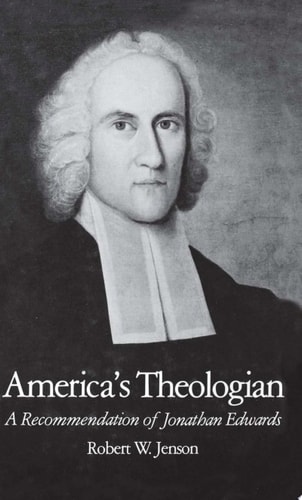
America's Theologian: A Recommendation of Jonathan Edwards
0
0
As an Amazon Associate and affiliate partner, Menrva Books earns from qualifying purchases. Learn more
Author Description
A great deal has recently been written about Jonathan Edwards. Most of it, however, does not make central Edwards's own intention to speak truth about God and the human situation; his systematic theological intention is regarded merely as an historical phenomenon. In this book, Robert Jenson provides a different sort of interpretation, asking not only, "Why was Edwards great?" but also, "Was Edwards right?" As a student of the ideas of Newton and Locke, Jenson argues, Edwards was very much a figure of the Enlightenment; but unlike most other Americans, he was also a discerning critic of it, and was able to use Enlightenment thought in his theology without yielding to its mechanistic and individualistic tendencies. Alone among Christian thinkers of the Enlightenment, Edwards conceived an authentically Christian piety and a creative theology not in spite of Newton and Locke but by virtue of them. Jenson sees Edwards's understanding as a radical corrective to what commitment to the Enlightenment brought about in American life, religious and otherwise. Perhaps, Jenson proposes, recovery of Edwards's vision might make the mutual determination of American culture and American Christianity more fruitful than it has yet been.
Menrva's Summary
THE THESIS
This book investigates whether the theological framework of Jonathan Edwards remains a valid and necessary corrective to the mechanistic tendencies of Enlightenment thought in modern American culture. Robert W. Jenson, a prominent theologian, utilizes his expertise in systematic theology to move beyond mere historical analysis of Edwards. Instead, he evaluates Edwards's intellectual synthesis of Newtonian and Lockean concepts to determine if his vision offers a viable path for contemporary Christian thought. Jenson argues that Edwards uniquely integrated Enlightenment philosophy without succumbing to its individualistic limitations.
THE SCOPE MAP
What You Will Find
- An analysis of Jonathan Edwards as a critical participant in Enlightenment discourse.
- A comparative study of Edwards's theology against the works of Isaac Newton and John Locke.
- A systematic evaluation of Edwards's potential to reshape the relationship between American culture and Christianity.
- A theological argument for the relevance of 18th-century piety in a modern context.
THE AUTHORITY PERSPECTIVE
Scholars and theologians frequently cite this work as a significant contribution to the study of American religious history and systematic theology. Experts highlight Jenson's ability to bridge the gap between historical biography and constructive theological argument, making it a standard text for those examining the intersection of Enlightenment philosophy and Christian doctrine.
Page Count:
238
Publication Date:
1988-06-23
Publisher:
Oxford University Press
ISBN-10:
0195049411
ISBN-13:
9780195049411
Philosophy
History
Biography
Theology
Enlightenment
Christianity
Community Tags
Similar Books