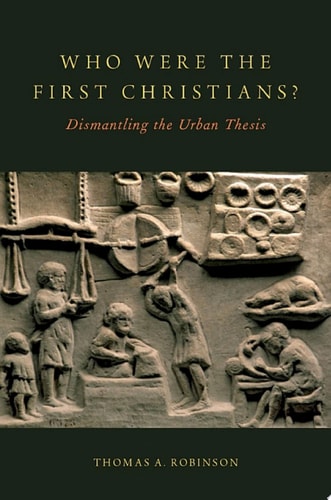
Who Were the First Christians?: Dismantling the Urban Thesis
0
0
As an Amazon Associate and affiliate partner, Menrva Books earns from qualifying purchases. Learn more
Author Description
Thomas Robinson argues that popular views of early Christian growth--one concentrated in urban environments--would nearly saturate every urban area of the entire Roman Empire with Christians, leaving no room for Jews or pagans. It is a scenario that simply does not work. But where does the solution lie? Robinson argues that the urban thesis is defective, and the neglected countryside must now be considered in any reconstruction of early Christian growth.
Menrva's Summary
THE THESIS
This book investigates the validity of the 'urban thesis,' which posits that early Christianity expanded primarily through urban centers, by testing its demographic and historical feasibility. Thomas A. Robinson, a scholar of early Christian history, utilizes demographic modeling and historical analysis to challenge the prevailing academic consensus. He argues that if the urban thesis were accurate, the resulting population density of Christians would have rendered the existence of other religious groups in Roman cities statistically impossible. The author proposes that the rural landscape, rather than the city, served as a more significant, yet overlooked, catalyst for the growth of the early church.
THE SCOPE MAP
What You Will Find
- Demographic analysis of Roman urban populations
- Critical evaluation of the 'urban thesis' framework
- Historical reconstruction of early Christian expansion patterns
- Comparative study of rural versus urban religious demographics
Scope Limits
- The text does not provide a comprehensive history of Christian theology
- It does not focus on the political history of the Roman Empire outside of demographic implications
THE AUTHORITY PERSPECTIVE
Scholars and historians frequently cite this work as a necessary corrective to urban-centric models of early church growth. Readers often note the academic rigor and the logical clarity with which Robinson dismantles established historical assumptions.
Page Count:
0
Publication Date:
2016-01-01
ISBN-10:
0190620579
ISBN-13:
9780190620578
Religion
History
Sociology of Religion
Christianity
Christian Church
Ancient History