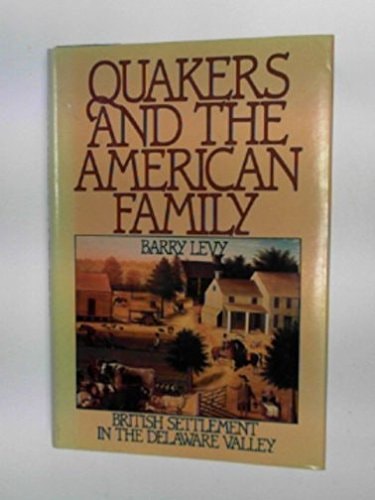
Quakers and the American Family: British Settlement in the Delaware Valley
0
0
As an Amazon Associate and affiliate partner, Menrva Books earns from qualifying purchases. Learn more
Author Description
Americans have an unusually strong family ideology. We believe that morally self-sufficient nuclear households must serve as the foundation of a republican society. In this brilliant history, Barry Levy traces this contemporary view of family life all the way back to the Quakers. Levy argues that the Quakers brought a new vision of family and social life to America--one that contrasted sharply with the harsh, formal world of the Puritans in New England. The Quaker emphasis was on affection, friendship and hospitality. They stressed the importance of women in the home, and of self-disciplined, non-coercive childrearing. This book explains how and why the Quakers' had such a profound cultural impact (and why more so in Pennsylvania and America than in England); and what the Quakers' experience with their own radical family system can tell us about American family ideology. Who were the Northwest British Quakers and why did their family system so impress English, French, and New England reformers--Voltaire, Crèvecouer, Brissot, Emerson, George Bancroft, Lydia Maria Child, and Lousia May Alcott, to name just a few? To answer this question, Levy tells the story of a large group of Quaker farmers from their development of a new family and communal life in England in the 1650s to their emigration and experience in Pennsylvania between 1681 and 1790. The book is thus simultaneously a trans-Atlantic community study of the migration and transplantation of ordinary British peoples in the tradition of Sumner Chilton Powell's Puritan Village; the story of the formation and development of a major Anglo-American faith; and an exploration of the origins of American family ideology.
Menrva's Summary
THE THESIS
This work investigates the historical origins of the modern American family ideology by tracing its roots to the Quaker settlers of the Delaware Valley. Barry Levy, utilizing a trans-Atlantic historical framework, examines how the specific social and religious practices of 17th-century British Quakers were transplanted to Pennsylvania. He argues that this unique Quaker vision of the household—centered on affection, non-coercive childrearing, and the elevated role of women—became a foundational element of American republican social structure, distinguishing it from the Puritan traditions of New England.
THE SCOPE MAP
What You Will Find
- A detailed historical analysis of Quaker migration patterns from England to the Delaware Valley between 1681 and 1790.
- A comparative study of Quaker family dynamics versus the social structures of New England Puritans.
- Examination of primary source accounts from 18th and 19th-century reformers who observed and documented Quaker communal life.
- An exploration of the transition from 1650s British communal practices to the development of a distinct Anglo-American faith.
THE AUTHORITY PERSPECTIVE
Historians and sociologists frequently cite this text as a foundational study for understanding the cultural evolution of the American nuclear family. Experts highlight the book's rigorous archival research and its success in linking specific religious practices to broader national social ideologies.
Page Count:
340
Publication Date:
1988-06-30
Publisher:
Oxford University Press
ISBN-10:
0195049756
ISBN-13:
9780195049756
Religion
History
Sociology
American History
Family Studies
Quakers
Community Tags
Similar Books














