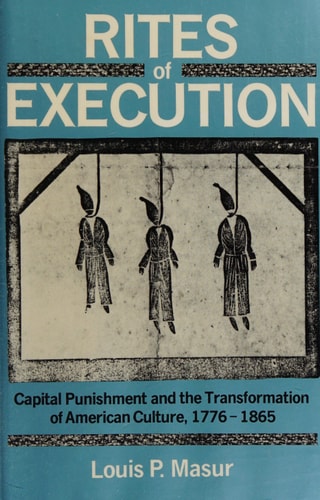
Rites of Execution: Capital Punishment and the Transformation of American Culture, 1776-1865
0
0
As an Amazon Associate and affiliate partner, Menrva Books earns from qualifying purchases. Learn more
Author Description
Between the seventeenth and nineteenth centuries, Western societies abandoned public executions in favor of private punishments, primarily confinement in penitentiaries and private executions. The transition, guided by a reconceptualization of the causes of crime, the nature of authority, and the purposes of punishment, embodied the triumph of new sensibilities and the reconstitution of cultural values throughout the Western world. This study examines the conflict over capital punishment in the United States and the way it transformed American culture between the Revolution and the Civil War. Relating the gradual shift in rituals of punishment and attitudes toward discipline to the emergence of a middle class culture that valued internal restraints and private punishments, Masur traces the changing configuration of American criminal justice. He examines the design of execution day in the Revolutionary era as a spectacle of civil and religious order, the origins of organized opposition to the death penalty and the invention of the penitentiary, the creation of private executions, reform organizations' commitment to social activism, and the competing visions of humanity and society lodged at the core of the debate over capital punishment. A fascinating and thoughtful look at a topic that remains of burning interest today, Rites of Execution will attract a wide range of scholarly and general readers.
Menrva's Summary
THE THESIS
This work investigates the historical transition from public to private executions in the United States and how this shift reflected broader changes in American cultural values and social discipline between 1776 and 1865. Louis P. Masur, a historian specializing in American culture, utilizes primary source documents, legal records, and reformist literature to argue that the movement toward private punishment was inextricably linked to the rise of a middle-class ethos emphasizing internal restraint. He posits that the debate over capital punishment served as a proxy for competing visions of human nature and the legitimate scope of state authority during the nation's formative years.
THE SCOPE MAP
What You Will Find
- Analysis of the shift from public spectacle executions to private penitentiary confinement.
- Examination of the emergence of organized anti-death penalty movements and reform organizations.
- Historical review of the Revolutionary era's approach to civil and religious order through public punishment.
- Exploration of the connection between criminal justice reform and the development of middle-class cultural sensibilities.
THE AUTHORITY PERSPECTIVE
Scholars and historians frequently cite this text as a foundational study for understanding the intersection of penal policy and cultural evolution in early America. Readers often note the academic rigor and the clarity with which Masur connects specific legal changes to the shifting moral landscape of the nineteenth century.
Page Count:
224
Publication Date:
1989-01-01
Publisher:
Oxford University Press
ISBN-10:
0195048997
ISBN-13:
9780195048995
History
Legal History
Sociology
Criminology
American History
Community Tags
Similar Books