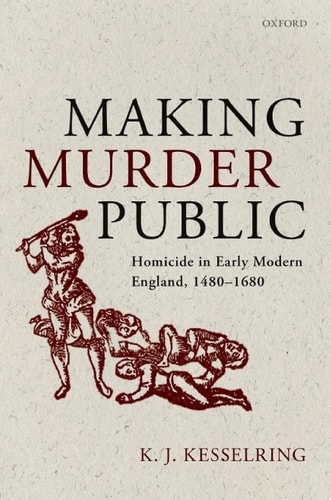
Making Murder Public: Homicide in Early Modern England, 1480-1680
0
0
As an Amazon Associate and affiliate partner, Menrva Books earns from qualifying purchases. Learn more
Author Description
Homicide has a history. In early modern England, that history saw two especially notable developments: one, the emergence in the sixteenth century of a formal distinction between murder and manslaughter, made meaningful through a lighter punishment than death for the latter, and two, a significant reduction in the rates of homicides individuals perpetrated on each other. Making Murder Public explores connections between these two changes. It demonstrates the value in distinguishing between murder and manslaughter, or at least in seeing how that distinction came to matter in a period which also witnessed dramatic drops in the occurrence of homicidal violence. Focused on the 'politics of murder', Making Murder Public examines how homicide became more effectively criminalized between 1480 and 1680, with chapters devoted to coroners' inquests, appeals and private compensation, duels and private vengeance, and print and public punishment. The English had begun moving away from treating homicide as an offence subject to private settlements or vengeance long before other Europeans, at least from the twelfth century. What happened in the early modern period was, in some ways, a continuation of processes long underway, but intensified and refocused by developments from 1480 to 1680. Making Murder Public argues that homicide became fully 'public' in these years, with killings seen to violate a 'king's peace' that people increasingly conflated with or subordinated to the 'public peace' or 'public justice.'
Menrva's Summary
THE THESIS
This book investigates how homicide transitioned from a private matter of vengeance to a public crime against the state in early modern England between 1480 and 1680. K. J. Kesselring, a historian specializing in early modern English legal and social history, utilizes legal records, coroners' inquests, and contemporary print media to construct her argument. She posits that the formalization of the distinction between murder and manslaughter, coupled with a decline in interpersonal violence, reflects a broader societal shift toward the centralization of justice under the concept of the 'public peace.'
THE SCOPE MAP
What You Will Find
- Analysis of the legal evolution regarding murder and manslaughter sentencing.
- Examination of the role of coroners' inquests in criminalizing violence.
- Discussion of the decline in private vengeance and dueling practices.
- Investigation into the influence of print culture on public perceptions of justice.
Scope Limits
- The study is geographically restricted to England.
- The analysis focuses primarily on the period between 1480 and 1680.
THE AUTHORITY PERSPECTIVE
Historians and legal scholars frequently cite this work as a significant contribution to the study of early modern criminal justice systems. Readers often note the academic density of the prose, which provides a rigorous examination of the shifting relationship between private settlement and state-sanctioned punishment.
Page Count:
195
Publication Date:
2019-01-01
Publisher:
OUP Oxford
ISBN-10:
0192572598
ISBN-13:
9780192572592
History
Early Modern
British History
Sociology
European History
Legal History
Criminology
Community Tags
Similar Books