Manifesting America: The Imperial Construction of U.S. National Space
0
0
As an Amazon Associate and affiliate partner, Menrva Books earns from qualifying purchases. Learn more
Author Description
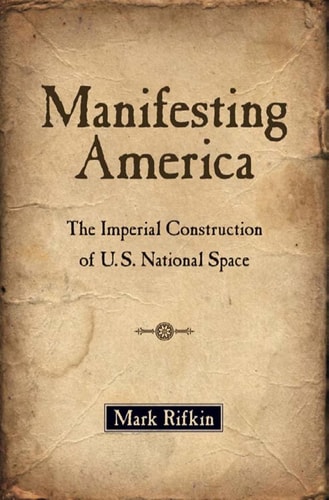
The expansion of the U.S. in the antebellum period relied on the claim that the nation's boundaries were both self-evident and dependent on the consent of those enclosed within them. While the removal of American Indians and racism toward former Mexicans has been well-documented, little attention has been paid to the legal rhetorics through which the incorporation of these peoples and their territories was justified, portraying them as actively agreeing to come under the authority of the U.S. Yet even as the creation and extension of U.S. jurisdiction functioned as an imperial system, it did not go unchallenged by dominated populations. In Manifesting America, Mark Rifkin explores how writings by Native Americans and former Mexicans protested the legal narratives that would normalize their absorption into U.S. national space.Focusing on Indian removal in the southeast and western Great Lakes regions as well as the annexation of Texas and California, the monograph tracks the confrontation between U.S. law and the self-representations of once-alien peoples newly subjected to it. Institutions in the U.S. legitimized conquest by creating forms of official recognition for dominated groups that reinforced the logic and justice of U.S. mappings. But the imposed mappings continued to be haunted by the persistence of earlier political geographies. Examining a variety of nonfictional writings (including memorials, autobiographies, and histories) produced by imperially displaced populations, Rifkin illustrates how these texts contest the terms and dynamics of U.S. policy by highlighting specific forms of collectivity and placemaking disavowed in official accounts. Persuasively argued and anchored with judicious research, Manifesting America provides an overdue chapter in the history of resistance to U.S. imperialism.
Menrva's Summary
THE THESIS
This work investigates how the United States utilized legal rhetoric and official recognition to justify the territorial expansion and incorporation of Native American and Mexican populations during the antebellum period. Author Mark Rifkin, a scholar of Native American and Indigenous studies, examines how the U.S. government constructed a narrative of consent to legitimize imperial conquest. By analyzing primary source documents, Rifkin argues that these legal frameworks were designed to normalize the absorption of diverse territories while simultaneously suppressing the political geographies of the displaced groups.
THE SCOPE MAP
What You Will Find
- Analysis of legal rhetorics regarding Indian removal in the southeast and western Great Lakes regions.
- Examination of the annexation of Texas and California as case studies for imperial expansion.
- A study of nonfictional writings including memorials, autobiographies, and histories produced by displaced populations.
- A framework for understanding how dominated groups utilized self-representation to contest official U.S. mappings.
THE AUTHORITY PERSPECTIVE
Scholars in the fields of history and political science frequently cite this text for its rigorous examination of the intersection between legal discourse and imperial expansion. Readers often note the academic density of the prose, which provides a foundational analysis for understanding the history of resistance to U.S. territorial policy.
Page Count:
288
Publication Date:
2009-10-27
Publisher:
Oxford University Press
ISBN-10:
0195387171
ISBN-13:
9780195387179
History
Land tenure
Imperialism
Legal History
English & College Success
Sociology
Nationalism
American History
English
Illegal Aliens
United States
Community Tags
Similar Books