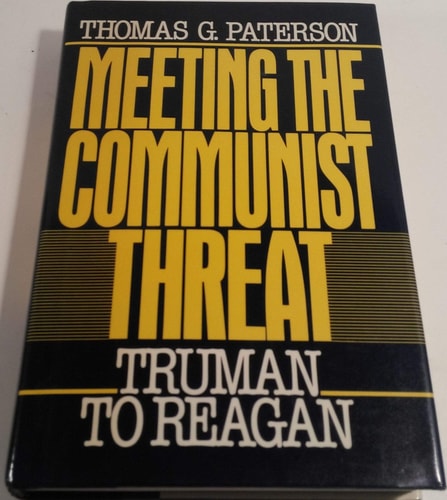
Meeting the Communist Threat: Truman to Reagan
0
0
As an Amazon Associate and affiliate partner, Menrva Books earns from qualifying purchases. Learn more
Author Description
In this provocative new book, the distinguished diplomatic historian Thomas G. Paterson explores why and how Americans have perceived and exaggerated the Communist threat in the last half century. Telling the story through rich analysis and substantial research in private papers, government archieves, oral histories, contemporary writings, and scholarly works, Paterson explains the origins and evolution of United States global intervention. In penetrating essays on the ideas and programs of Harry S. Truman, George F. Kennan, Dwight D. Eisenhower, John Foster Dulles, John F. Kennedy, Richard M. Nixon, Henry A. Kissisnger, and Ronald Reagan, as well as on the views of dissenters from the prevailing Cold War mentality, Paterson reveals the tenacity and momentum of American thinking about threats from abroad.Paterson offers a thorough review of postwar American attitudes toward totalitariansim, the causes of international conflict, and foreign aid, and he then demonstrates how Truman acted upon these views, launched the containment doctrine, and exercised American power in both Europe and Asia. A fresh look at Eisenhower's policy in the Middle East explains how the United States became a major player in that volatile region. Paterson also presents an incisive critique of Kennedy's foreign policy, describing an administration propelled by lessons from Truman's era, an assertive, "can-do" style, and a grandiose notion of America's nation-building responsibilities in the Third World. Arrogance, ignorance, and impatience, Paterson argues, combined with familiar exaggerations of Soviet capabilities and intentions, to produce a rash of crises, from the Bay of Pigs and missile crisis in Cuba to the war in Vietnam.Other chapters study the flawed record of 1970s détente, CIA covert actions and the failure of congressional oversight from the 1940s to the present, and Reagan's rewriting of the history of the Vietnam War. In the last chapter, Paterson demolishes the argument that t
Menrva's Summary
THE THESIS
This work investigates the origins and evolution of United States global interventionism by examining how American policymakers perceived and frequently exaggerated the threat of Communism from the Truman administration through the Reagan era. Thomas G. Paterson, a distinguished diplomatic historian, utilizes a vast array of primary sources including private papers, government archives, oral histories, and contemporary writings to construct his argument. He posits that a persistent Cold War mentality, characterized by arrogance and a misunderstanding of foreign capabilities, drove American foreign policy decisions that often resulted in international crises and overreach.
THE SCOPE MAP
What You Will Find
- Analysis of foreign policy doctrines from the Truman era through the Reagan administration.
- Case studies on specific geopolitical interventions including the Middle East, Cuba, and Vietnam.
- Examination of the role of the CIA and the limitations of congressional oversight in covert operations.
- Critique of the ideological foundations of containment, détente, and nation-building in the Third World.
THE AUTHORITY PERSPECTIVE
Experts recognize this text as a rigorous contribution to the historiography of the Cold War, noting its critical stance on American interventionist policies. Readers frequently highlight the depth of the archival research and the clarity with which Paterson connects individual administrative decisions to broader patterns of national behavior.
Page Count:
334
Publication Date:
1988-03-24
Publisher:
Oxford University Press
ISBN-10:
0195045335
ISBN-13:
9780195045338
History
Diplomatic History
Cold War
International relations
Community Tags
Other Editions(2)
Similar Books
Reader Comments
Share Your Thoughts
No comments yet. Be the first to share your thoughts!