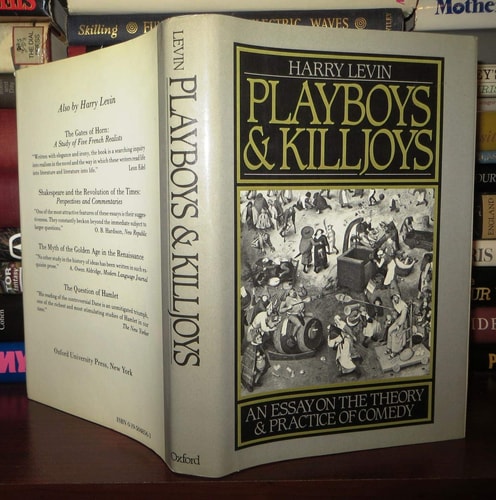
Playboys and Killjoys: An Essay on the Theory and Practice of Comedy
0
0
As an Amazon Associate and affiliate partner, Menrva Books earns from qualifying purchases. Learn more
Author Description
Harry Levin is one of the major literary critics in America. This book is a brilliant and original study of the whole world of comedy, concentrating on playwrights through the centuries, from Aristophanes and Plautus in classical times to Bernard Shaw and Bertolt Brecht and their recent successors.Theories about the subject of comedy have abounded, but they have generally been divorced from theatrical practice. The alternative--discussions of plays and playwrights, without defining or analyzing the problems they have in common--is also unsatisfying. Moreover, many critics, in trying to make the subject of humor "respectable" have treated the subject humorlessly, while others have succumbed to the temptation to be flip.Levin views the comic repertory as a richly variegated but broadly unified whole and provides a synthesis of theory and practice plus a further synthesis of theories heretofore regarded as conflicting. He isolated two fundamental aspects of comedy: one centers on the ludicrous (irresponsible, irreverent) "playboy" whom we laugh with, and the other on the ridiulous (pretentious, forbidding) "killjoy", whom we laugh at. Levin traces the dialectical interplay of these components throughout history and across various cultures and media. He places strong emphasis on such major dramatists as Shakespeare, Ben Jonson, Molière, and William Congreve. He comments on the nature and theory of comedy as enunciated by such famous figures as George Meredith and Henri Bergson, and includes essays on such related ideas as humor, satire, and games; but the emphasis throughout is on the plays and on the stage, with incidental reference to comedians like Charlie Chaplin and the Marx Brothers.
Menrva's Summary
THE THESIS
This work investigates the fundamental dialectic of comedy by reconciling theoretical frameworks with the practical realities of theatrical performance. Harry Levin, a distinguished scholar of comparative literature at Harvard University, utilizes his extensive background in dramatic history to bridge the gap between abstract definitions of humor and the actual mechanics of stagecraft. He argues that comedy is defined by the interplay between the 'playboy'—the figure of irreverent, ludic freedom—and the 'killjoy'—the figure of pretentious, rigid authority. By synthesizing historical theories with a close reading of major playwrights, Levin provides a unified perspective on the comic tradition.
THE SCOPE MAP
What You Will Find
- A historical survey of comedic drama ranging from Aristophanes and Plautus to Shaw and Brecht.
- A theoretical framework categorizing comedic characters into the archetypes of the 'playboy' and the 'killjoy'.
- Analysis of major dramatists including Shakespeare, Ben Jonson, Molière, and William Congreve.
- Critical commentary on the theories of humor, satire, and play as articulated by figures like Henri Bergson and George Meredith.
THE AUTHORITY PERSPECTIVE
Scholars and critics recognize this text as a significant contribution to the study of dramatic theory, particularly for its ability to balance academic rigor with an appreciation for the stage. Readers frequently note the density of the prose, which demands a high level of familiarity with the classical and modern dramatic canon.
Page Count:
222
Publication Date:
1987-02-19
Publisher:
Oxford University Press
ISBN-10:
0195048563
ISBN-13:
9780195048568
Drama
Non-Fiction
Literary Criticism
Theater Studies
Comedy
Community Tags
Other Editions(2)
Similar Books