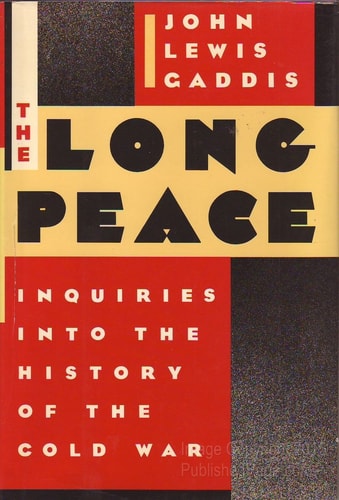
The Long Peace: Inquiries Into the History of the Cold War
0
0
As an Amazon Associate and affiliate partner, Menrva Books earns from qualifying purchases. Learn more
Author Description
How has it happened that the United States and the Soviet Union have managed to get through more than four decades of Cold War confrontation without going to war with one another? Historian John Lewis Gaddis suggests answers to this and other vital questions about postwar diplomacy in his new book, The Long Peace: Inquiries into the History of the Cold War.Gaddis uses recently-declassified American and British documents to explore several key issues in Cold War history that remain unresolved: Precisely what was it about the Soviet Union's behavior after World War II that American leaders found so threatening? Did the United States really want a sphere of influence in postwar Europe? What led the Truman administration first to endorse, but then immediately to back away from, a strategy designed to avoid American military involvement on the mainland of Asia? Why did the United States not use nuclear weapons during the decade in which it had an effective monopoly over them? Did American leaders really believe in the existence of an international communist "monolith"? How did Russians and Americans fall into the habit of not shooting down each other's reconnaisance satellites?Relating these questions to the current status of Soviet-American relations, Gaddis makes a strong case for the relative stability of the postwar international system, a stability whose components include--and go well beyond --nuclear deterrence. The result is a provocative exercise in contemporary history, certain to generate interest, discussion, and, in the end, important new insights on both past and present aspects of the age in which we live.
Menrva's Summary
THE THESIS
This work investigates the mechanisms and historical factors that prevented direct military conflict between the United States and the Soviet Union during the four decades of the Cold War. John Lewis Gaddis, a preeminent historian of the Cold War era, utilizes a rigorous analytical framework to examine the stability of the postwar international system. By synthesizing recently declassified American and British archival documents, he challenges conventional narratives regarding nuclear deterrence and superpower behavior. The book argues that the absence of a third world war resulted from a complex interplay of diplomatic, strategic, and systemic factors rather than a single cause.
THE SCOPE MAP
What You Will Find
- Analysis of declassified American and British diplomatic and military records from the post-World War II era.
- Examination of the evolution of American containment strategies and perceptions of the Soviet Union.
- Investigation into the decision-making processes regarding nuclear weapons usage and reconnaissance technology.
- Assessment of the structural stability of the bipolar international system during the mid-twentieth century.
THE AUTHORITY PERSPECTIVE
Experts and historians widely regard this text as a foundational contribution to Cold War historiography. Readers frequently note the academic density of the prose, which provides a comprehensive and nuanced understanding of superpower diplomacy for both students and scholars of international relations.
Page Count:
352
Publication Date:
1987-10-08
Publisher:
Oxford University Press
ISBN-10:
0195043367
ISBN-13:
9780195043365
History
Cold War
International relations
Diplomacy
Military History
Community Tags
Similar Books