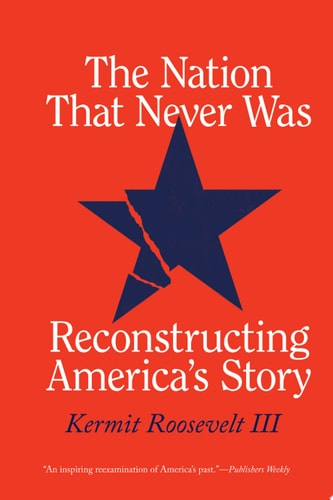
The Nation That Never Was: Reconstructing America's Story
0
0
As an Amazon Associate and affiliate partner, Menrva Books earns from qualifying purchases. Learn more
Author Description
Our idea of the Founders' America and its values is not true. We are not the heirs of the Founders, but we can be the heirs of Reconstruction and its vision for equality. There’s a common story we tell about America: that our fundamental values as a country were stated in the Declaration of Independence, fought for in the Revolution, and made law in the Constitution. But, with the country increasingly divided, this story isn’t working for us anymore—what’s more, it’s not even true. As Kermit Roosevelt argues in this eye-opening reinterpretation of the American story, our fundamental values, particularly equality, are not part of the vision of the Founders. Instead, they were stated in Lincoln’s Gettysburg Address and were the hope of Reconstruction, when it was possible to envision the emergence of the nation committed to liberty and equality. We face a dilemma these days. We want to be honest about our history and the racism and oppression that Americans have both inflicted and endured. But we want to be proud of our country, too. In The Nation That Never Was, Roosevelt shows how we can do both those things by realizing we’re not the country we thought we were. Reconstruction, Roosevelt argues, was not a fulfillment of the ideals of the Founding but rather a repudiation: we modern Americans are not the heirs of the Founders but of the people who overthrew and destroyed that political order. This alternate understanding of American identity opens the door to a new understanding of ourselves and our story, and ultimately to a better America. America today is not the Founders’ America, but it can be Lincoln’s America. Roosevelt offers a powerful and inspirational rethinking of our country’s history and uncovers a shared past that we can be proud to claim and use as a foundation to work toward a country that fully embodies equality for all.
Menrva's Summary
THE THESIS
The Nation That Never Was challenges the conventional narrative of American identity by arguing that the nation's core values, particularly equality, were not established by the Founders but were forged during the Reconstruction era following the Civil War.
THE SCOPE MAP
- A reinterpretation of American history, positing Reconstruction as a repudiation of the Founding ideals rather than their fulfillment.
- An examination of the tension between acknowledging historical racism and maintaining national pride.
- An argument for embracing Lincoln's vision and the ideals of Reconstruction as the true foundation for American identity.
- An analysis of how this alternate understanding can lead to a more equitable future America.
THE AUTHORITY PERSPECTIVE
The book offers a provocative re-evaluation of American history, suggesting that the ideals of equality are more closely tied to the Reconstruction era than to the Founding Fathers. It aims to reconcile a truthful acknowledgment of past injustices with a sense of national pride by reframing American identity around the post-Civil War period. The work encourages readers to consider a new narrative that can serve as a foundation for a more inclusive future.
Page Count:
256
Publication Date:
2023-10-17
Publisher:
University of Chicago Press
ISBN-10:
0226829510
ISBN-13:
9780226829517
Non-Fiction
History
Politics
Civil War
Reconstruction Era
American History
Community Tags
Similar Books














