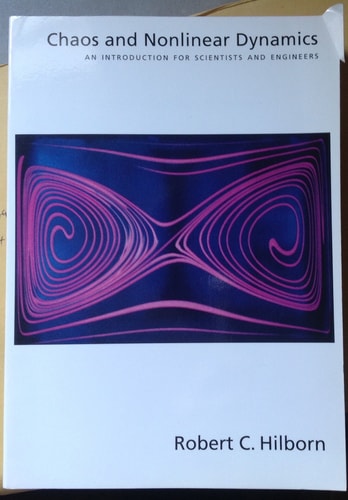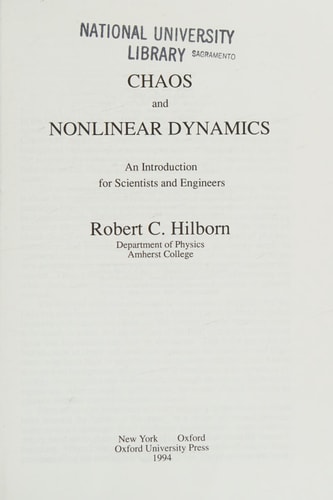
Chaos and Nonlinear Dynamics: An Introduction for Scientists and Engineers
0
0
As an Amazon Associate and affiliate partner, Menrva Books earns from qualifying purchases. Learn more
Author Description
This is the only book that introduces the full range of activity in the rapidly growing field of nonlinear dynamics to an audience of students, scientists, and engineers with no in-depth experience in the area. The text uses a step-by-step explanation of dynamics and geometry in state space as a foundation for understanding nonlinear dynamics. It goes on to provide a thorough treatment of such key topics as differential equation models and iterated map models (including a derivation of the famous Feigenbaum numbers), the surprising role of number theory in dynamics, and an introduction to Hamiltonian dynamics. This is the only book written at this introductory level to include the increasingly important field of pattern formation, along with a survey of the controversial questions of quantum chaos. Important analytical tools, such as Lyapunov exponents, Kolmogorov entropies, and fractal dimensions, are treated in detail. With over 200 figures and diagrams, and both analytic and computer exercises following every chapter, the book is ideally suited for use as a text or for self-instruction. An extensive collection of annotated references brings the reader into contact with the literature in nonlinear dynamics, which the reader will be prepared to tackle after completing the book.
Menrva's Summary
THE THESIS
This book investigates the fundamental principles of nonlinear dynamics and chaos theory, providing a comprehensive entry point for students and professionals in scientific and engineering fields. Robert C. Hilborn, a physicist with extensive experience in the field, constructs a pedagogical framework that bridges the gap between basic dynamics and complex chaotic systems. By utilizing state space geometry and differential equations, the author establishes a rigorous foundation for understanding how nonlinear systems evolve and behave over time.
THE SCOPE MAP
What You Will Find
- Detailed analysis of differential equation models and iterated map models.
- Mathematical derivations of Feigenbaum numbers and their significance in bifurcation theory.
- Technical explanations of analytical tools including Lyapunov exponents, Kolmogorov entropies, and fractal dimensions.
- Explorations into pattern formation and the theoretical framework of quantum chaos.
THE AUTHORITY PERSPECTIVE
Experts and educators frequently cite this work as a foundational text for those entering the field of nonlinear dynamics due to its clear, step-by-step methodology. Readers often note the academic density of the prose, which is balanced by the inclusion of over 200 diagrams and practical exercises that facilitate self-instruction.
Page Count:
672
Publication Date:
1994-01-06
Publisher:
Oxford University Press
ISBN-10:
0195057600
ISBN-13:
9780195057607
Science
Chaotic behavior in systems
Engineering
Dynamics
Nonlinear theories
Mathematics
Physics
Chaos Theory
Nonlinear Dynamics
Community Tags
Similar Books