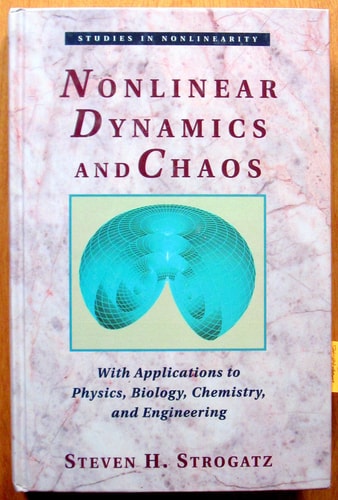
Nonlinear Dynamics and Chaos: With Applications to Physics, Biology, Chemistry and Engineering
0
0
As an Amazon Associate and affiliate partner, Menrva Books earns from qualifying purchases. Learn more
Author Description
This textbook is aimed at newcomers to nonlinear dynamics and chaos, especially students taking a first course in the subject. The presentation stresses analytical methods, concrete examples and geometric intuition. The theory is developed systematically, starting with first-order differential equations and their bifurcations, followed by phase plane analysis, limit cycles and their bifurcations, and culminating with the Lorenz equations, chaos, iterated maps, period doubling, renormalization, fractals, and strange attractors.A unique feature of the book is its emphasis on applications. These include mechanical vibrations, lasers, biological rhythms, superconducting circuits, insect outbreaks, chemical oscillators, genetic control systems, chaotic waterwheels, and even a technique for using chaos to send secret messages. In each case, the scientific background is explained at an elementary level and closely integrated with the mathematical theory.Richly illustrated, and with many exercises and worked examples, this book is ideal for an introductory course at the junior/senior or first-year graduate level. It is also ideal for the scientist who has not had formal instruction in nonlinear dynamics, but who now desires to begin informal study. The prerequisites are multivariable calculus and introductory physics.
Menrva's Summary
THE THESIS
This text investigates the fundamental principles of nonlinear dynamics and chaos, providing a structured framework for understanding complex systems across diverse scientific disciplines. Steven H. Strogatz, a professor of mathematics, utilizes a pedagogical approach that prioritizes geometric intuition and analytical rigor. By integrating mathematical theory with concrete physical, biological, and chemical applications, the author establishes a comprehensive foundation for students and researchers alike.
THE SCOPE MAP
What You Will Find
- Systematic development of first-order differential equations and bifurcation theory.
- Detailed analysis of phase planes, limit cycles, and strange attractors.
- Practical applications including mechanical vibrations, biological rhythms, and superconducting circuits.
- Extensive problem sets, worked examples, and illustrative diagrams for self-study or classroom use.
THE AUTHORITY PERSPECTIVE
Experts and educators widely recognize this work as the standard introductory text for the field due to its accessible prose and clear geometric explanations. Readers frequently note that the balance between theoretical derivation and real-world application makes it an ideal resource for both undergraduate students and professionals seeking to expand their mathematical toolkit.
Page Count:
512
Publication Date:
1994-04-20
Publisher:
CRC Press
ISBN-10:
0201543443
ISBN-13:
9780201543445
Science
Physics
Nonlinear Dynamics
Dynamics
Engineering
Mathematics
Chaos Theory
Chaotic behavior in systems
Nonlinear theories
Community Tags
Similar Books