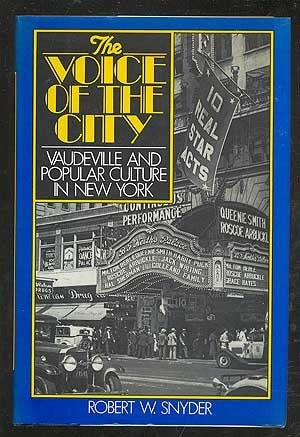
The Voice of the City: Vaudeville and Popular Culture in New York
0
0
As an Amazon Associate and affiliate partner, Menrva Books earns from qualifying purchases. Learn more
Author Description
From 1880 to 1930, the vaudeville show reigned as the most popular form of entertainment in America. Vaudeville was a meeting place--an inclusive form of theatre that fostered cultural interaction between New Yorkers. With its daredevils, comics, tear-jerkers, slapstick clowns, and crooners, vaudeville succeeded in presenting as many voices as New York City itself, allowing them to swell together in a chorus rarely in unison, sometimes in harmony, and always as loud, brassy, and quintessentially New York as the sound of the subway train roaring into Times Square.Robert Snyder's entertaining and enlightening book depicts the rise of popular culture in America by brilliantly recapturing the essence and commercial trappings of one of its most vital forms of entertainment--the vaudeville show. Snyder reconstructs famous acts such as Eddie Cantor, Sophie Tucker, and Weber and Fields; describes the different theaters from Broadway's famous Palace to local Bronx and Brooklyn venues; and demonstrates how entrepreneurs such as B.F. Keith and E.F. Albee created a near monopoly over bookings, theaters, and performers.First exploring the early transformation of the variety theater into a more tasteful form of entertainment for middle-class women, men, and their families, he then introduces us to such influential showmen as Tony Pastor, who took vaudeville out of the Bowery without taking the Bowery completely out of vaudeville. He brings us to the opening of Keith and Albee's theater on Union Square and describes their efforts to make vaudeville a nationwide industry, along the way offering lively descriptions of the performances of Maggie Cline, the lusty-voiced "Irish Queen" of Tony Pastor's theater, Eubie Blake, the ragtime pianist, composer, and son of former slaves, and countless others. He also shows us vaudeville's decline, with the appropriation of vaudeville audiences by musical comedy, radio, and, most importantly, motion pictures, and the Depression and the closing of theaters.
Menrva's Summary
THE THESIS
This book investigates how vaudeville functioned as a central pillar of American popular culture and a mirror for the social dynamics of New York City between 1880 and 1930. Robert W. Snyder, a historian of urban culture, utilizes archival records and performance history to argue that vaudeville was not merely entertainment, but a critical site of cultural negotiation. He examines the transition of variety theater into a structured industry, highlighting the roles of both performers and the entrepreneurs who sought to standardize the medium for a broad, middle-class audience.
THE SCOPE MAP
What You Will Find
- A detailed history of the vaudeville industry from 1880 to 1930.
- Analysis of the business models employed by theater magnates like B.F. Keith and E.F. Albee.
- Profiles of iconic performers including Eddie Cantor, Sophie Tucker, and Eubie Blake.
- Examination of the socio-economic factors leading to the decline of vaudeville in the face of radio and motion pictures.
THE AUTHORITY PERSPECTIVE
Historians and theater scholars frequently cite this work as a foundational text for understanding the commercialization of American popular entertainment. Readers often note the balance between detailed business history and the vibrant, anecdotal accounts of the performers who defined the era.
Page Count:
244
Publication Date:
1989-11-23
Publisher:
Oxford University Press
ISBN-10:
0195052854
ISBN-13:
9780195052855
History
American History
Vaudeville
New York
Cities And Towns
Cultural History
Theater
Community Tags
Similar Books