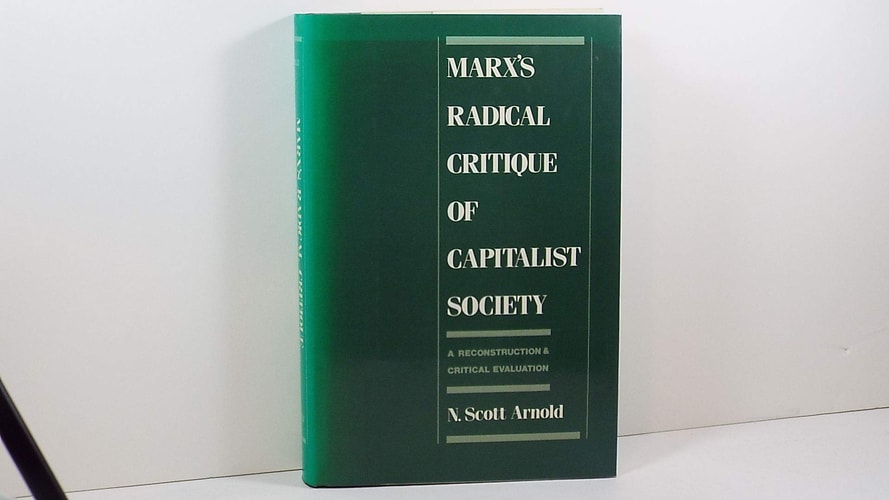
Marx's Radical Critique of Capitalist Society: A Reconstruction and Critical Evaluation
0
0
As an Amazon Associate and affiliate partner, Menrva Books earns from qualifying purchases. Learn more
Author Description
Exactly what did Marx find objectionable about capitalist society? Scattered throughout his writings (and those of his collaborator, Engels) is a systematic--and thoroughly radical--answer to this question. Marx believed that the ills of capitalist society are neither accidental nor incidental; instead they are embedded in the very structure of the capitalist economic system. This book articulates and critically evaluates the Marxist charges against capitalism of exploitation and alienation, and argues that Marx's radical critique of capitalist society presupposes a set of alternative institutions without the defects attributed to capitalism. A careful analysis of Marx's vision of the two phases or stages of post-capitalist society (later called "socialism" and "communism") reveals that neither vision could be realized. It has often been said that Marxism works in theory but not in practice; this book contends that it does not work in theory.
Menrva's Summary
THE THESIS
This book investigates the logical consistency and practical viability of Karl Marx's critique of capitalist society. N. Scott Arnold, a professor of philosophy, examines the foundational charges of exploitation and alienation within Marx's work. By analyzing the structural components of capitalism as described by Marx and Engels, the author argues that the proposed post-capitalist alternatives are theoretically flawed and ultimately unrealizable.
THE SCOPE MAP
What You Will Find
- A systematic reconstruction of Marxist critiques regarding capitalist economic structures.
- Critical evaluation of the concepts of exploitation and alienation.
- Analysis of the two proposed stages of post-capitalist society: socialism and communism.
- Logical assessment of the theoretical coherence of Marxist economic theory.
THE AUTHORITY PERSPECTIVE
Scholars and students of political philosophy frequently cite this work for its rigorous analytical approach to Marxist theory. Experts highlight the text as a significant contribution to the debate over whether Marxist critiques hold up under logical scrutiny.
Page Count:
352
Publication Date:
1990-03-29
Publisher:
Oxford University Press
ISBN-10:
0195058798
ISBN-13:
9780195058796
Philosophy
Economics
Marxism
Social Theory
Community Tags
Similar Books