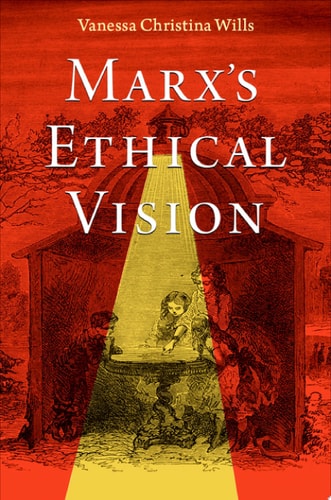
Marx's Ethical Vision
0
0
As an Amazon Associate and affiliate partner, Menrva Books earns from qualifying purchases. Learn more
Author Description
"The communists do not preach morality at all"; this line from The Communist Manifesto might seem to settle the question of whether Marxism has anything to offer moral philosophy. Yet, Marx issued both trenchant critiques of "bourgeois" morality and thundering condemnations of capitalism's "vampire-like" destructiveness. He decried commodity-exchange for corroding our ability to value one another for who we are, not how much our lives could be traded away for. He expressed apparently ethical views about human nature, the conditions necessary for human flourishing, and the desirability of bringing such conditions about--views that are interwoven throughout his life's work, from his youthful philosophical poetry to his unfinished masterpiece, Capital.Renewed attention to Marx's distinctively "dialectical" and historical materialist approach to conflict and change makes sense of this apparent tension in his thought. Following Marx, Vanessa Christina Wills centers labor--human beings satisfying their needs through conscious, purpose-driven, and transformative interaction with the material world--as the essential human activity. Working people's struggles reveal capitalism's worst ravages while pointing to a better future and embodying the only way there: rational transformation of our relationships to ourselves, to one another, and to the natural world, so that the human condition emerges not as a burden we must bear but as life we joyfully create. The purposiveness of labor gives rise to a normativity already inherent in the present state of things, one that can guide us in knowing what sort of world we should build and that further prepares us to build it.Rather than "preach morality," the key task for moral philosophy is to theorize in the light that working peoples' struggles for survival shine on capitalism--an existential threat to humanity and the defining ethical problem of our time.
Menrva's Summary
THE THESIS
This book investigates whether Karl Marx’s work contains a coherent moral philosophy despite his explicit rejection of traditional moralizing. Vanessa Christina Wills, a scholar of philosophy, examines the apparent contradiction between Marx’s critique of bourgeois morality and his own normative condemnations of capitalist exploitation. By analyzing Marx’s writings from his early poetry to his later economic treatises, Wills argues that Marx’s ethical framework is rooted in his dialectical and historical materialist understanding of human labor and social transformation.
THE SCOPE MAP
What You Will Find
- A re-evaluation of Marx's critique of commodity exchange and its impact on human value.
- An analysis of labor as the central, purpose-driven activity that defines the human condition.
- A synthesis of historical materialism as a framework for identifying normative goals within existing social struggles.
- An exploration of how working-class resistance provides the necessary insight for building a more ethical future.
THE AUTHORITY PERSPECTIVE
Scholars and students of political philosophy recognize this work as a significant contribution to the ongoing debate regarding the normative foundations of Marxist thought. Readers frequently note the clarity with which Wills navigates complex dialectical concepts to provide a accessible yet rigorous ethical analysis.
Page Count:
320
Publication Date:
2024-08-09
Publisher:
Oxford University Press
ISBN-10:
0197688144
ISBN-13:
9780197688144
Politics
Philosophy
Ethics & Morality
Social Philosophy
Ethics
Social Theory
Schools & Teaching
Marxism
Community Tags
Other Editions(2)
Similar Books








Reader Comments
Share Your Thoughts
No comments yet. Be the first to share your thoughts!