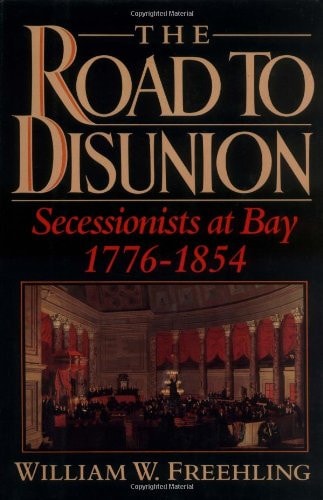
The Road to Disunion, Volume I: Secessionists at Bay, 1776-1854
0
0
As an Amazon Associate and affiliate partner, Menrva Books earns from qualifying purchases. Learn more
Author Description
Far from a monolithic block of diehard slave states, the South in the eight decades before the Civil War was, in William Freehling's words, "a world so lushly various as to be a storyteller's dream." It was a world where Deep South cotton planters clashed with South Carolina rice growers, where the egalitarian spirit sweeping the North seeped down through border states already uncertain about slavery, where even sections of the same state (for instance, coastal and mountain Virginia) divided bitterly on key issues. It was the world of Jefferson Davis, John C. Calhoun, Andrew Jackson, and Thomas Jefferson, and also of Gullah Jack, Nat Turner, and Frederick Douglass.Now, in the first volume of his long awaited, monumental study of the South's road to disunion, historian William Freehling offers a sweeping political and social history of the antebellum South from 1776 to 1854. All the dramatic events leading to secession are here: the Missouri Compromise, the Nullification Controversy, the Gag Rule ("the Pearl Harbor of the slavery controversy"), the Annexation of Texas, the Compromise of 1850, and the Kansas-Nebraska Act. Freehling vividly recounts each crisis, illuminating complex issues and sketching colorful portraits of major figures. Along the way, he reveals the surprising extent to which slavery influenced national politics before 1850, and he provides important reinterpretations of American republicanism, Jeffersonian states' rights, Jacksonian democracy, and the causes of the American Civil War.But for all Freehling's brilliant insight into American antebellum politics, Secessionists at Bay is at bottom the saga of the rich social tapestry of the pre-war South. He takes us to old Charleston, Natchez, and Nashville, to the big house of a typical plantation, and we feel anew the tensions between the slaveowner and his family, the poor whites and the planters, the established South and the newer South, and especially between the slave and his master, "Cuffee" an
Menrva's Summary
THE THESIS
This volume investigates the complex political and social fractures within the American South that transformed a diverse collection of states into a unified secessionist movement between 1776 and 1854. William W. Freehling, a prominent historian of the antebellum period, utilizes extensive archival research and political analysis to challenge the notion of a monolithic South. He argues that internal regional, economic, and social tensions—rather than a singular ideology—shaped the trajectory toward the American Civil War. By examining the interplay between national policy and local interests, Freehling provides a framework for understanding how slavery dictated the evolution of American republicanism and democracy.
THE SCOPE MAP
What You Will Find
- A detailed chronological analysis of major political crises including the Missouri Compromise, the Nullification Controversy, and the Kansas-Nebraska Act.
- Examination of the socioeconomic divide between coastal rice growers, mountain farmers, and Deep South cotton planters.
- Primary source analysis of key political figures such as John C. Calhoun, Andrew Jackson, and Thomas Jefferson alongside the perspectives of enslaved individuals.
- A reinterpretation of the influence of slavery on the development of American political institutions and states' rights doctrines.
THE AUTHORITY PERSPECTIVE
Historians and scholars frequently cite this work as a foundational text for understanding the nuanced political landscape of the antebellum South. Readers often note the density of the prose, which provides a comprehensive and rigorous examination of the era's complex legislative and social history.
Page Count:
656
Publication Date:
1990-09-06
Publisher:
Oxford University Press
ISBN-10:
0195058143
ISBN-13:
9780195058147
History
Social History
American History
Slavery
Political History
Southern States
Civil War
Community Tags
Similar Books