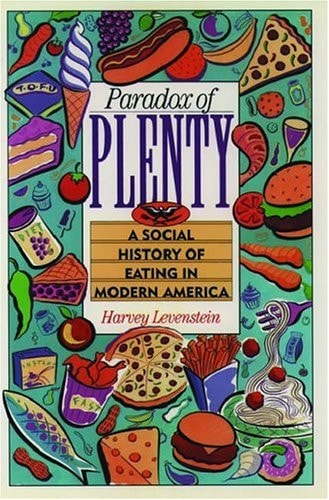
Paradox of Plenty: A Social History of Eating in Modern America
0
0
As an Amazon Associate and affiliate partner, Menrva Books earns from qualifying purchases. Learn more
Author Description
America has always been blessed with an abundance of food, but when it comes to the national diet, it is a land of stark contrast and paradox. In the early months of the Depression, for instance, there were 82 breadlines in New York City alone, and food riots broke out in such places as Henryetta, Oklahoma, and England, Arkansas. Yet at the same time, among those who were better-off, absurd weight-loss diets were the rage - the Pineapple-and-Lamb-Chop Diet, the "Mayo Diet" of raw tomatoes and hard-boiled eggs, and even a Coffee-and-Donuts Diet. Why do Americans eat what they eat? And why, in a land of plenty, do so many eat so poorly?In Paradox of Plenty, Harvey Levenstein offers a sweeping social history of food and eating in America, exploring the economic, political, and cultural factors that have shaped the American diet from 1930 to the present. Levenstein begins with the Great Depression, describing the breadlines and the slim-down diets, the era's great communal eating fests - the picnics, barbecues, fish fries, and burgoo feasts - and the wave of "vitamania" which swept the nation before World War II, breeding fears that the national diet was deficient in the so-called "morale vitamin." He discusses wartime food rationing and the attempts of Margaret Mead and other social scientists to change American eating habits, and he examines the postwar "Golden Age of American Food Processing," when Duncan Hines and other industry leaders convinced Americans that they were "the best-fed people on Earth." He depicts the disillusionment of the 1960s, when Americans rediscovered hunger and attacked food processors for denutrifying the food supply, and he shows how President Kennedy helped revive the mystique of French food (and how Julia Child helped demystify it). Finally, he discusses contemporary eating habits, the national obsession with dieting, cholesterolphobia, "natural" foods, the demographics of fast-food chains, and the expanding role of food processors as a s
Menrva's Summary
THE THESIS
What factors have historically influenced the American diet, and why does a nation with abundant food resources struggle with widespread nutritional deficiencies and dietary paradoxes? Harvey A. Levenstein, a historian specializing in the social history of food, utilizes economic data, political records, and cultural analysis to trace the evolution of American eating habits from the 1930s to the late 20th century. He argues that the American relationship with food is defined by a tension between industrial processing, scientific intervention, and shifting cultural ideals of health and status.
THE SCOPE MAP
What You Will Find
- A chronological analysis of American dietary trends from the Great Depression through the late 1980s.
- Examination of the influence of government policy, wartime rationing, and social science on national eating habits.
- Historical documentation of the rise of the food processing industry and its impact on consumer perception.
- Exploration of the cultural shift toward dieting, health fads, and the gourmet movement.
THE AUTHORITY PERSPECTIVE
Historians and sociologists frequently cite this work as a foundational text for understanding the intersection of industrialization and domestic life in the United States. Scholars note that the prose is accessible to general readers while maintaining the rigorous research standards expected in academic social history.
Page Count:
368
Publication Date:
1993-01-14
Publisher:
Oxford University Press
ISBN-10:
0195055438
ISBN-13:
9780195055436
History
United States
Diet
American History
Social Science
Food And Drink
Community Tags
Similar Books