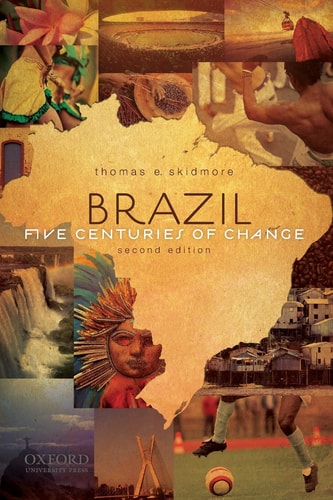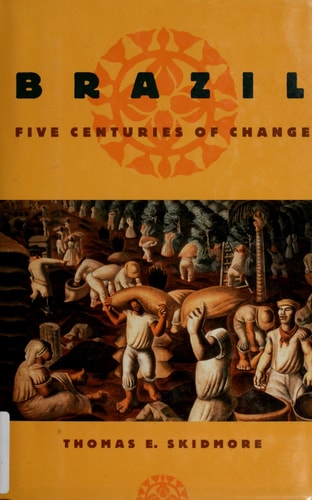
Brazil: Five Centuries of Change
0
0
As an Amazon Associate and affiliate partner, Menrva Books earns from qualifying purchases. Learn more
Author Description
With a land mass larger than the continental United States, a unique culture that is part European, African, and indigenous, and the largest economy in Latin America, Brazil is one of the most important--yet one of the least understood--nations in the world.Thomas Skidmore, a preeminent authority on Brazil, vividly traces the 500 years of Brazil's development. Its epic story begins in the wake of Vasco da Gama's historic circumnavigation of the globe, when another Portuguese vessel, commanded by Pedro Alvares Cabral, ran aground on the coast of Brazil in April 1500. From there Skidmore probes Portugal's remarkable command of the vast country in the face of the advances of the Spanish, French, and Dutch colonial interests; Brazil's compromised independence in 1822; its evolution as the center of world coffee cultivation; and the creation of the republic in the late nineteenth century. He also examines its unique forms of modernist art and literature, the dictatorship of Getulio Vargas and the military coups, and the liberal reforms of current President Fernando Henrique Cardoso. Informed by the most recent scholarship available, Brazil explores the country's many blessings: ethnic diversity, racial democracy, a vibrant cultural life, and a wealth of natural resources. But, as Skidmore writes, the Brazilians must also grapple with a history of political instability and military rule, a deplorable environmental record, chronic inflation, and international debt. An ideal choice for undergraduate and graduate courses in Latin American history, this eloquent and detailed look at Brazil will be the standard history of the country for years to come..
Menrva's Summary
THE THESIS
How did Brazil evolve from a Portuguese colonial outpost into a complex, modern nation-state grappling with both immense natural wealth and persistent political instability? Thomas E. Skidmore, a recognized scholar of Brazilian history, synthesizes five centuries of development to explain the country's unique cultural and economic trajectory. By examining the interplay between colonial legacy, agricultural expansion, and modern political shifts, the author provides a comprehensive framework for understanding Brazil's current global standing.
THE SCOPE MAP
What You Will Find
- A chronological analysis of Brazilian history from the 1500 arrival of Pedro Alvares Cabral to the late 20th-century reforms.
- Examination of key socio-political eras, including the Vargas dictatorship, military coups, and the transition to a republic.
- Analysis of economic drivers such as the coffee industry, international debt, and resource management.
- Exploration of cultural identity, focusing on the synthesis of European, African, and indigenous influences.
THE AUTHORITY PERSPECTIVE
Experts and academics frequently cite this work as a foundational text for students of Latin American history due to its balanced and thorough narrative. Readers often note the clarity of the prose, which manages to distill complex political and economic history into an accessible format for both undergraduate and graduate study.
Page Count:
272
Publication Date:
1999-03-25
Publisher:
Oxford University Press
ISBN-10:
0195058100
ISBN-13:
9780195058109
History
Brazil history
Brazil
Social History