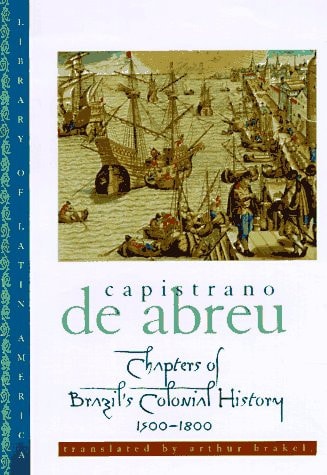
Chapters of Brazil's Colonial History, 1500-1800
0
0
As an Amazon Associate and affiliate partner, Menrva Books earns from qualifying purchases. Learn more
Author Description
In all the history of Latin America, few historians have been so influential as the Brazilian scholar Joao Capistrano de Abreu. His own life reflected the changes that swept his country and his academy: the nineteenth century scion of a remote Brazilian province, he paid his way to the capital by selling a slave he had inherited; he went on to bring Brazilian history into the twentieth century, moving it from patriotic sentimentalism to rigorous, rational scholarship. Now, for the first time, his central work, a classic of historical literature, appears in a sharp, clear English translation.In Chapters in Brazil's Colonial History, Abreu created an integrated history of Brazil in a landmark work of scholarship that is also a literary masterpiece. Breaking with previous writers, who had taken a plodding governor after governor approach that rested upon administration and politics, Abreu offers a startlingly modern analysis of the past, based on the role of the economy, settlement, and the occupation of the interior. In these pages, he combines sharp portraits of dramatic events--close fought battles against Dutch occupation in the 1650s, Indian resistance to often brutal internal expansion--with insightful social history. A master of Brazil's ethnographic landscape, he provides detailed sketches of daily life for Brazilians of all stripes. Abreu first won acclaim for a linguistic study of a Brazilian Indian language; he brings that knowledge to play as he describes the interaction between colonial settlers, African slaves, and native inhabitants, as cultures mixed in the creation of the modern nation. He also stresses the role of the physical landscape and environment in ways that presaged contemporary developments in historical scholarship. And along the way, his distinctive voice provides the reader with rare pleasure. After quoting a vivid description of a typical seventeenth century atrocity, for example, he interrupts his narrative to ask, "Do horrors such as th
Menrva's Summary
THE THESIS
How did the interplay of economic forces, environmental factors, and social dynamics shape the formation of colonial Brazil? João Capistrano de Abreu, a foundational figure in Brazilian historiography, challenges the traditional administrative-focused historical narrative by shifting the focus toward the occupation of the interior and the complex interactions between settlers, indigenous populations, and enslaved Africans. His work serves as a transition from patriotic sentimentalism to a rigorous, analytical approach that integrates ethnographic detail with economic history.
THE SCOPE MAP
What You Will Find
- Analysis of the colonial period in Brazil from 1500 to 1800.
- Examination of the economic drivers behind settlement and interior expansion.
- Ethnographic insights into the cultural synthesis of European, African, and indigenous groups.
- Historical accounts of military conflicts, including the resistance against Dutch occupation.
THE AUTHORITY PERSPECTIVE
Experts recognize this work as a foundational text that modernized Brazilian historical scholarship by moving beyond simple political chronologies. Readers often note the author's distinctive, analytical voice which provides a sophisticated perspective on the social and environmental complexities of the colonial era.
Page Count:
272
Publication Date:
1997-11-20
Publisher:
Oxford University Press
ISBN-10:
0195103017
ISBN-13:
9780195103014
History
Historiography
Brazil history
Social History
Brazil
Colonial History
Community Tags
Similar Books