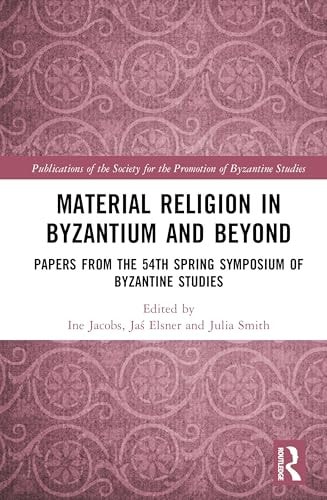
Material Religion in Byzantium and Beyond: Papers from the 54th Spring Symposium of Byzantine Studies
0
0
As an Amazon Associate and affiliate partner, Menrva Books earns from qualifying purchases. Learn more
Author Description
The theoretical framework known as Material Religion has emerged as a vibrant and profoundly influential approach within religious studies over the past two decades. Originating in the first decade of the 21st century from currents within cultural anthropology, Material Religion challenges a foundational assumption of much modern Western thought: that matter and spirit -- materiality and religion -- are fundamentally opposed. Rather than conceiving religion primarily as a system of ideas, doctrines, and beliefs, this framework accords equal significance to behaviours, practices, and objects. It reorients the study of religion towards the physical world, while simultaneously highlighting the capacity of tangible environments to mediate between humans and extraordinary powers. This volume introduces the insights of Material Religion to the field of Byzantine studies. It presents Material Religion as a new theoretical lens to Byzantinists, who have long explored religious life through behaviours, practices, and material culture, and who have long recognised their significance. A series of case studies -- encompassing individual sites, urban spaces, landscape features, and categories of objects -- illustrates the relevance and analytical power of the framework across the full span of Byzantine material culture, from Late Antiquity to the Fall of Constantinople, including instances of cultural exchange within and beyond the Empire's heartland. Material Religion in Byzantium and Beyond will appeal to a broad audience, from students of Byzantium to established scholars who may be unfamiliar with the Material Religion framework.
Menrva's Summary
THE THESIS
This volume introduces the theoretical framework of Material Religion to the field of Byzantine studies, challenging the modern Western dichotomy between matter and spirit. The framework, which emerged in the early 21st century, posits that religion is not solely a system of beliefs but also encompasses behaviors, practices, and objects, thereby reorienting the study of religion towards the physical world and the mediation of extraordinary powers through tangible environments. The book presents this new theoretical lens to Byzantinists, who have long recognized the significance of material culture in religious life. It offers a series of case studies that span Late Antiquity to the Fall of Constantinople, illustrating the framework's analytical power across various aspects of Byzantine material culture, including sites, urban spaces, landscapes, and objects, as well as instances of cultural exchange.
THE SCOPE MAP
- Introduction to the Material Religion framework and its relevance to Byzantine studies.
- Exploration of how matter and spirit are not opposed in religious studies.
- Focus on behaviors, practices, and objects as significant components of religion.
- Case studies of individual sites and their religious significance.
- Analysis of urban spaces and their role in mediating religious experiences.
- Examination of landscape features and their connection to extraordinary powers.
- Inclusion of diverse categories of objects within Byzantine material culture.
- Coverage of the Byzantine period from Late Antiquity to the Fall of Constantinople, including cultural exchange.
THE AUTHORITY PERSPECTIVE
The theoretical framework of Material Religion has gained significant traction in religious studies over the past two decades, offering a novel perspective that challenges traditional dichotomies between the material and spiritual. This volume aims to introduce this influential approach to scholars of Byzantine studies, a field that has historically recognized the importance of material culture in religious practices. The collection of case studies is designed to demonstrate the analytical power of the Material Religion framework across the broad spectrum of Byzantine history and material culture. It is anticipated that the book will appeal to both specialists in Byzantine studies and those new to the Material Religion framework, fostering interdisciplinary dialogue.
Page Count:
416
Publication Date:
2025-11-03
Publisher:
Routledge, Chapman & Hall, Incorporated
ISBN-10:
1032791713
ISBN-13:
9781032791715
Non-Fiction
History
Anthropology
Community Tags
Similar Books