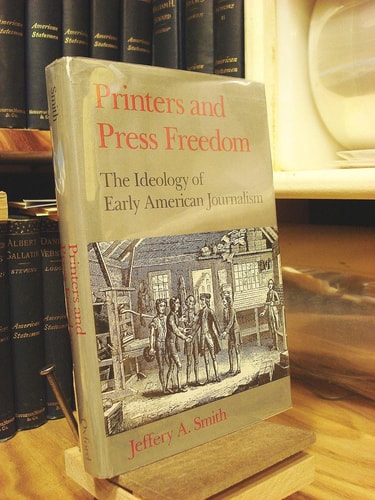
Printers and Press Freedom: The Ideology of Early American Journalism
0
0
As an Amazon Associate and affiliate partner, Menrva Books earns from qualifying purchases. Learn more
Author Description
In the United States, the press has sometimes been described as an unoffical fourth branch of government, a branch that serves as a check on the other three and provides the information necessary for a democracy to function. Freedom of the press--guaranteed but not defined by the First Amendment of the Constitution--can be fully understood only when examined in the context of the political and intellectual experiences of 18th-century America. Here, Jeffery A. Smith explores how Madison, Franklin, Jefferson, and their contemporaries came to see liberty of the press as a natural and vital part of a democratic republic. Drawing on sources ranging from political philosophers to court records and newspaper essayists, Printers and Press Freedom traces the development of a widespread conception of the press as necessarily exempt from all government restrictions, but still liable for the defamation of individuals. Smith carefully analyzes libertarian press theory and practice in the context of republican ideology and Enlightenment thought--paying particular attention to the cases of Benjamin Franklin and his relatives and associates in the printing business--and concludes that the generation that produced the First Amendment believed that government should not be trusted and that the press needed the broadest possible protection in order to serve as a check on the misuse of power.
Menrva's Summary
THE THESIS
This work investigates the origins and evolution of press freedom as a foundational element of early American democratic ideology. Jeffery A. Smith, a scholar of journalism history, examines the intellectual and political climate of the 18th century to determine how the Founding Fathers conceptualized the role of the press. By analyzing the intersection of Enlightenment philosophy and republican theory, the author argues that the First Amendment was rooted in a profound distrust of government power and a belief that the press required broad protections to function as a necessary check on authority.
THE SCOPE MAP
What You Will Find
- Analysis of 18th-century political philosophy and Enlightenment thought regarding liberty.
- Examination of legal precedents and court records concerning defamation and government restriction.
- Case studies focusing on the printing business of Benjamin Franklin and his associates.
- Exploration of the development of libertarian press theory within the context of the American republic.
THE AUTHORITY PERSPECTIVE
Historians and legal scholars frequently cite this text as a foundational resource for understanding the intellectual history of the First Amendment. Readers often note the academic rigor and the depth of primary source research that Smith employs to contextualize early American journalism.
Page Count:
248
Publication Date:
1987-11-19
Publisher:
Oxford University Press
ISBN-10:
0195051440
ISBN-13:
9780195051445
History
Journalism
United States
Constitutional Law
Freedom of the press
Journalism history
American History
Community Tags
Similar Books