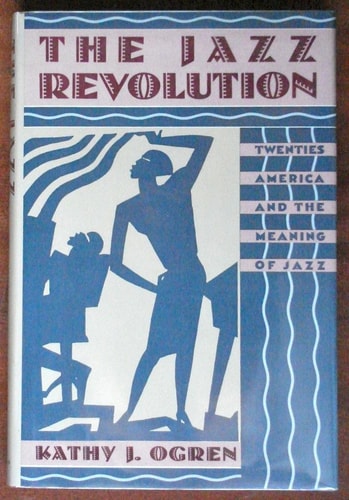
The Jazz Revolution: Twenties America and the Meaning of Jazz
0
0
As an Amazon Associate and affiliate partner, Menrva Books earns from qualifying purchases. Learn more
Author Description
Born of African rhythms, the spiritual "call and response," and other American musical traditions, jazz was by the 1920s the dominant influence on this country's popular music. Writers of the Harlem Renaissance (Langston Hughes, Claude McKay, Zora Neale Hurston) and the "Lost Generation" (Malcolm Cowley, F. Scott Fitzgerald, and Gertrude Stein), along with many other Americans celebrated it--both as an expression of black culture and as a symbol of rebellion against American society. But an equal number railed against it. Whites were shocked by its raw emotion and sexuality, and blacks considered it "devil's music" and criticized it for casting a negative light on the black community.In this illuminating work, Kathy Ogren places this controversy in the social and cultural context of 1920s America and sheds new light on jazz's impact on the nation as she traces its dissemination from the honky-tonks of New Orleans, New York, and Chicago, to the clubs and cabarets of such places as Kansas City and Los Angeles, and further to the airwaves. Ogren argues that certain characteristics of jazz, notably the participatory nature of the music, its unusual rhythms and emphasis, gave it a special resonance for a society undergoing rapid change. Those who resisted the changes criticized the new music; those who accepted them embraced jazz. In the words of conductor Leopold Stowkowski, "Jazz [had] come to stay because it [was] an expression of the times, of the breathless, energetic, superactive times in which we [were] living, it [was] useless to fight against it."Numerous other factors contributed to the growth of jazz as a popular music during the 1920s. The closing of the Storyville section of New Orleans in 1917 was a signal to many jazz greats to move north and west in search of new homes for their music. Ogren follows them to such places as Chicago, New York, and San Francisco, and, using the musicians' own words as often as possible, tells of their experiences in the clubs
Menrva's Summary
THE THESIS
This work investigates how jazz functioned as both a catalyst for and a reflection of the profound social and cultural transformations occurring in 1920s America. Kathy J. Ogren, a historian of American culture, utilizes primary source accounts from musicians and contemporary critics to analyze the polarized reception of the genre. She argues that the participatory nature and rhythmic innovation of jazz provided a unique sonic landscape for a society grappling with rapid modernization and shifting racial dynamics.
THE SCOPE MAP
What You Will Find
- An analysis of the migration of jazz musicians from New Orleans to urban centers like Chicago, New York, and Los Angeles.
- Examination of the intersection between jazz and the Harlem Renaissance and the Lost Generation literary movements.
- Documentation of the moral and social controversies surrounding jazz, including its perception as both a symbol of rebellion and a threat to traditional values.
- A study of the technological and economic factors, such as the rise of radio, that facilitated the dissemination of jazz as a popular American art form.
THE AUTHORITY PERSPECTIVE
Scholars and music historians frequently cite this text as a foundational study for understanding the sociological impact of jazz during the interwar period. Readers often note the author's effective use of primary source narratives to ground the broader cultural analysis in the lived experiences of the musicians themselves.
Page Count:
240
Publication Date:
1989-02-23
Publisher:
Oxford University Press
ISBN-10:
019505153X
ISBN-13:
9780195051537
Music
History
American History
Jazz
Social History
Music
Community Tags
Similar Books