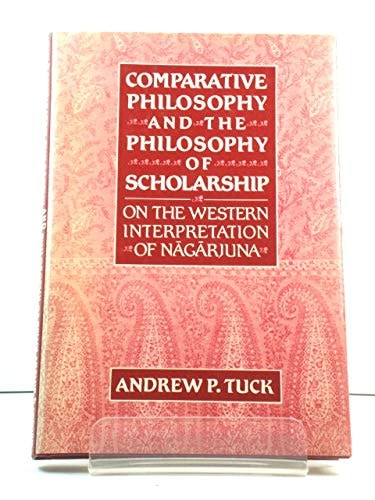
Comparative Philosophy and the Philosophy of Scholarship: On the Western Interpretation of Nagarjuna
0
0
As an Amazon Associate and affiliate partner, Menrva Books earns from qualifying purchases. Learn more
Author Description
This study in cross-cultural hermeneutics examines the role that modern, Western philosophy has played in the interpretation of Nagarjuna's Madhyamikakarika, a second-century Indian-Buddhist text. Tuck locates a structure of distinct phases or "styles" in modern, philosophical history. These phases, Tuck shows, exhibit discontinuous interpretive biases, as well as continuity of hermeneutic intention. Discovering in each philosophical era a chaacteristic attitude towards the text--whether privilege, objectivity, or neutrality--Tuck argues that the continual reinterpretation of earlier scholarly readings is in fact at the core of fruitful hermeneutic pursuit.
Menrva's Summary
THE THESIS
This work investigates how Western philosophical frameworks and shifting intellectual biases have shaped the interpretation of Nagarjuna's Madhyamikakarika over time. Andrew P. Tuck, a scholar of comparative philosophy, utilizes a historical analysis of academic reception to demonstrate that interpretations of Indian-Buddhist texts are rarely neutral. He argues that the evolution of scholarly understanding is defined by distinct, discontinuous phases that reflect the prevailing philosophical attitudes of the Western era in which they were produced.
THE SCOPE MAP
What You Will Find
- A historical analysis of Western hermeneutic approaches to the Madhyamikakarika.
- A categorization of interpretive styles including privilege, objectivity, and neutrality.
- An examination of the continuity of hermeneutic intention despite shifting biases.
- A meta-theoretical argument regarding the necessity of reinterpreting previous scholarly readings.
THE AUTHORITY PERSPECTIVE
Experts in the field of comparative philosophy recognize this text as a significant contribution to the study of cross-cultural hermeneutics. Readers frequently note the academic density of the prose, which is intended for scholars and advanced students of Buddhist philosophy.
Page Count:
144
Publication Date:
1990-07-19
Publisher:
Oxford University Press
ISBN-10:
019506156X
ISBN-13:
9780195061567
Philosophy
Hermeneutics
Academic
Buddhism
Comparative Philosophy
Community Tags
Similar Books