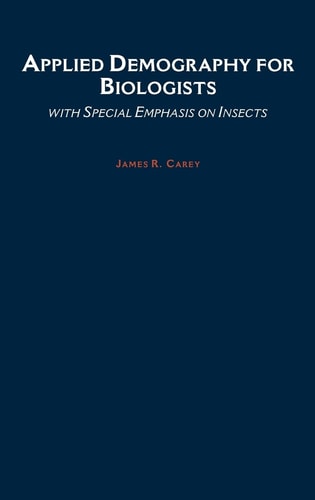
Applied Demography for Biologists: With Special Emphasis on Insects
0
0
As an Amazon Associate and affiliate partner, Menrva Books earns from qualifying purchases. Learn more
Author Description
This is the first book to comprehensively apply the fundamental tools and concepts of demography to a nonhuman species. It provides clear and concise treatment of standard demographic techniques such as life table analysis and population projection; introduces models that have seldom appeared outside of the demographic literature including the multiple decrement life table, the intrinsic sex ratio, and multiregional demography; and addresses demographic problems that are unique to nonhuman organisms such as the demographic theory of social insects and harvesting techniques applied to insect mass rearing. The book also contains a synthesis of fundamental properties of population such as momentum and convergence to the stable age distribution, with a section on the unity of demographic models, and appendices detailing analytical methods used to quantify and model the data gathered in a ground-breaking study on the mortality experience of 1.2 million medflies. Based on an insect demography course at the University of California, Davis, the book is intended for practicing entomologists, population biologists, and ecologists for use in research or as a graduate text.
Menrva's Summary
THE THESIS
This book investigates the application of human demographic tools and mathematical models to the study of nonhuman species, specifically insects. James R. Carey, a professor at the University of California, Davis, leverages his extensive research on insect populations to bridge the gap between human demography and biological science. The text provides a rigorous framework for analyzing population dynamics, mortality, and life history through established quantitative methods. By synthesizing these techniques, the author offers a comprehensive resource for researchers and students to model biological data with precision.
THE SCOPE MAP
What You Will Find
- Life table analysis and population projection methodologies.
- Advanced demographic models including multiple decrement life tables and multiregional demography.
- Specialized applications for social insects and mass rearing harvesting techniques.
- Empirical data and analytical methods derived from a study of 1.2 million medflies.
THE AUTHORITY PERSPECTIVE
Experts recognize this work as a foundational text for applying human demographic theory to entomological research. Readers frequently note the technical density of the prose, which is designed for graduate-level study and professional application in population biology.
Page Count:
224
Publication Date:
1993-02-04
Publisher:
Oxford University Press
ISBN-10:
0195066871
ISBN-13:
9780195066876
Science
Biology
Ecology
Demography
Reference
Entomology
Community Tags
Similar Books