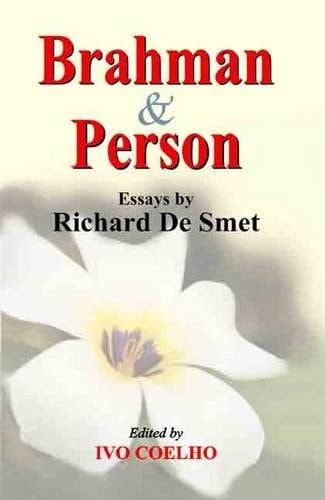
Brahman & Person: Essays by Richard De Smet
0
0
As an Amazon Associate and affiliate partner, Menrva Books earns from qualifying purchases. Learn more
Author Description
Brahman and Person is a collection of essays by the late Richard De Smet (1916-1997) on the topic of person in Indian thought. Overturning the current interpretation, De Smet proposes that the nirguna Brahman can be regarded as properly personal, provided person is understood in the original and classical sense that emerged in the Christian effort to speak about the mysteries of the Trinity and the Incarnation. The rendering of Saguna and nirguna Brahman as personal and impersonal, instead, originated with the Western translators of Sanskrit works, who were influenced by an individualistic idea of the person and the consequent restriction of its application to the human being. De Smet also dedicated attention to the question of the human person in Indian and Western thought over a number of essays, proposing that a properly holistic and organic notion of the human person can be found especially in the thought of Sankara. This collection of essays by an eminent Indologist constitutes an important contribution not only to Indological studies but also to crosscultural and inter-religious dialogue
Menrva's Summary
THE THESIS
The book investigates the concept of 'person' within Indian thought, challenging prevailing interpretations. Richard De Smet, a noted Indologist, argues that the nirguna Brahman can be understood as personal, provided 'person' is defined in its classical, theological sense. He contends that the Western translators, influenced by an individualistic view of personhood, incorrectly rendered Saguna and nirguna Brahman as personal and impersonal, respectively. The collection also explores the notion of the human person in both Indian and Western traditions, finding a holistic model particularly in Sankara's philosophy.
THE SCOPE MAP
- Analysis of the concept of 'person' in Indian philosophical traditions.
- Reinterpretation of nirguna Brahman as potentially personal.
- Critique of Western translators' influence on the understanding of Brahman.
- Exploration of the human person in Indian and Western thought.
- Identification of Sankara's philosophy as a model for a holistic human person.
- Contribution to Indological studies and cross-cultural dialogue.
THE AUTHORITY PERSPECTIVE
This collection of essays by Richard De Smet is presented as a significant contribution to Indological studies and inter-religious dialogue. The work aims to overturn current interpretations by proposing a personal understanding of nirguna Brahman, drawing parallels with Christian theological concepts of personhood. It critiques the influence of Western philosophical biases on the translation and interpretation of Indian texts. The essays also delve into the concept of the human person, highlighting Sankara's thought as a model for a holistic view.
Page Count:
294
Publication Date:
2010-02-09
Publisher:
Motilal Banarsidass
ISBN-10:
8120834593
ISBN-13:
9788120834590
Religion
Non-Fiction
Philosophy
Comparative Philosophy
Indian philosophy
Community Tags
Similar Books