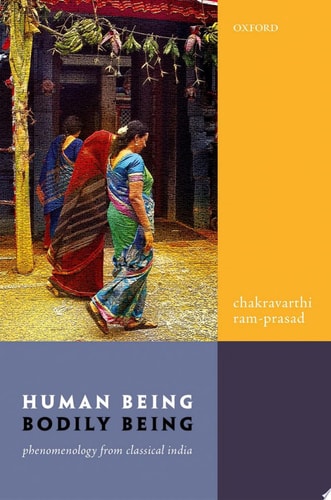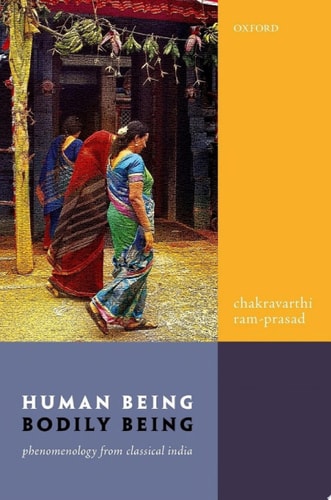
Human Being, Bodily Being: Phenomenology from Classical India
0
0
As an Amazon Associate and affiliate partner, Menrva Books earns from qualifying purchases. Learn more
Author Description
Chakravarthi Ram-Prasad offers illuminating new perspectives on contemporary phenomenological theories of body and subjectivity, based on studies of classical Indian texts that deal with bodily subjectivity. Examining four texts from different genres - a medical handbook, epic dialogue, a manual of Buddhist practice, and erotic poetry - he argues for a 'phenomenological ecology' of bodily subjectivity in health, gender, contemplation, and lovemaking. An ecology is a continuous and dynamic system of interrelationships between elements, in which the salience accorded to some type of relationship clarifies how the elements it relates are to be identified. The paradigm of ecological phenomenology obviates the need to choose between apparently incompatible perspectives of the human. The delineation of body is arrived at by working back phenomenologically from the world of experience, with the acknowledgement that the point of arrival - a conception of what counts as bodiliness - is dependent upon the exact motivation for attending to experience, the areas of experience attended to, and the expressive tools available to the phenomenologist. Ecological phenomenology is pluralistic, yet integrates the ways experience is attended to and studied, permitting apparently inconsistent intuitions about bodiliness to be explored in novel ways. Rather than seeing particular framings of our experience as in tension with each other, we should see each such framing as playing its own role according to the local descriptive and analytic concern of a text.
Menrva's Summary
THE THESIS
How can classical Indian texts provide a framework for understanding the complex relationship between bodily subjectivity and human experience? Chakravarthi Ram-Prasad, a scholar of Indian philosophy, utilizes a diverse set of classical texts to argue for a 'phenomenological ecology' of the body. He posits that by analyzing how different genres frame the body—ranging from medical to erotic contexts—we can move beyond binary conflicts in contemporary phenomenological theory to a more integrated, pluralistic understanding of human bodiliness.
THE SCOPE MAP
What You Will Find
- A comparative analysis of four distinct classical Indian genres: medical handbooks, epic dialogues, Buddhist practice manuals, and erotic poetry.
- The development of the 'phenomenological ecology' framework to resolve tensions between different conceptions of the body.
- A methodology for working back from the world of experience to define the parameters of bodily subjectivity.
Scope Limits
- The study does not provide an exhaustive history of Indian medical or religious thought.
- It does not attempt to create a singular, universal definition of the body, but rather focuses on how specific contexts shape its meaning.
THE AUTHORITY PERSPECTIVE
Scholars in the field of comparative philosophy recognize this work as a sophisticated bridge between Western phenomenological discourse and classical Indian intellectual traditions. Readers frequently note the academic density of the prose, which is intended for those with a background in philosophical inquiry or South Asian studies.
Page Count:
212
Publication Date:
2018-01-01
Publisher:
OUP Oxford
ISBN-10:
0192556738
ISBN-13:
9780192556738
Philosophy
Comparative Philosophy
Indian philosophy
Subjectivity
Mind & Body
Body Studies
Phenomenology
Community Tags
Similar Books