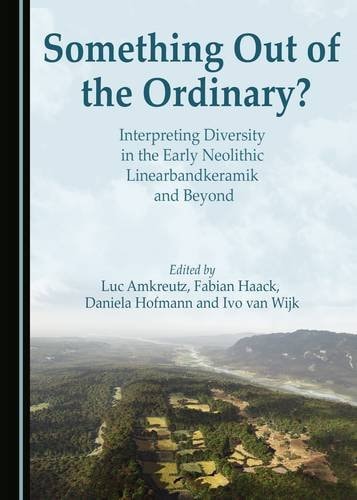
Something Out of the Ordinary? Interpreting Diversity in the Early Neolithic Linearbandkeramik and Beyond
0
0
As an Amazon Associate and affiliate partner, Menrva Books earns from qualifying purchases. Learn more
Author Description
More than 7000 years ago, groups of early farmers (the Linearbandkeramik, or LBK) spread over vast areas of Europe. Their cultural characteristics comprised common choices and styles of execution, with a central meaning and functionality attached to â ~doing things a certain wayâ (TM), over an enormous geographical area. However, recent evidence suggests that the reality was much more varied and diverse. The central question of this book is the extent to which notions of â ~uniformityâ (TM) and â ~diversityâ (TM) have caused a wider shift in archaeological perspective. Using the LBK case study as a starting point, the volume brings together contributions by international specialists tackling the notion of cultural diversity and its explanatory power in archaeological analysis more generally. Through discussions of the domestic architecture, stone tool inventory, pottery traditions, landscape use and burial traditions of the LBK, this book provides a crucial reappraisal of the cultureâ (TM)s potential for adaptability and change. Papers in the second part of the volume are devoted to archaeological case studies from around the globe in which the tension between diversity and uniformity has also proved controversial, including the Near Eastern Halaf culture, the North American Mississippian, the Pacific expansion of the Lapita culture, and the European Bell Beaker phenomenon. All provide exciting theoretical and methodological contributions on how the appreciation of cultural diversity as a whole can be moved forward. These papers expose diversity and uniformity as cultural strategies, and as such provide essential reading for scholars in archaeology and anthropology, and for anyone interested in the interplay between material culture and human social change.
Menrva's Summary
THE THESIS
This volume investigates the tension between perceived uniformity and actual diversity within early Neolithic cultures, particularly the Linearbandkeramik (LBK), and its implications for archaeological interpretation. The book challenges the traditional view of LBK cultural homogeneity by presenting recent evidence of variation. It explores how the concepts of 'uniformity' and 'diversity' have shaped archaeological perspectives, using the LBK as a primary case study to examine adaptability and change through its domestic architecture, tool inventories, pottery, landscape use, and burial traditions. The second part expands this discussion to global archaeological case studies, including the Halaf, Mississippian, Lapita, and Bell Beaker cultures, to advance theoretical and methodological approaches to understanding cultural diversity as a strategic element in human social change.
THE SCOPE MAP
- Analysis of the Linearbandkeramik (LBK) culture's spread and characteristics over 7000 years ago.
- Examination of domestic architecture, stone tool inventory, pottery traditions, landscape use, and burial traditions of the LBK.
- Reappraisal of the LBK culture's potential for adaptability and change.
- Case studies from around the globe: Near Eastern Halaf culture, North American Mississippian, Pacific Lapita culture, and European Bell Beaker phenomenon.
- Theoretical and methodological contributions to appreciating cultural diversity in archaeological analysis.
- Exploration of diversity and uniformity as cultural strategies.
- Contributions from international specialists in archaeology and anthropology.
THE AUTHORITY PERSPECTIVE
The book is presented as essential reading for scholars in archaeology and anthropology, and for those interested in the relationship between material culture and human social change. It aims to move forward the appreciation of cultural diversity by exposing it as a cultural strategy, alongside uniformity. The collection of papers offers theoretical and methodological insights derived from diverse archaeological case studies, suggesting a comprehensive approach to understanding past societies. The volume's focus on reappraising established cultural narratives through the lens of diversity is intended to stimulate new perspectives in the field.
Page Count:
515
Publication Date:
2016-01-01
Publisher:
Cambridge Scholars Publishing
ISBN-10:
1443886041
ISBN-13:
9781443886048
Non-Fiction
History
Cultural Diversity
Anthropology
Archaeology
Community Tags
Similar Books















Reader Comments
Share Your Thoughts
No comments yet. Be the first to share your thoughts!