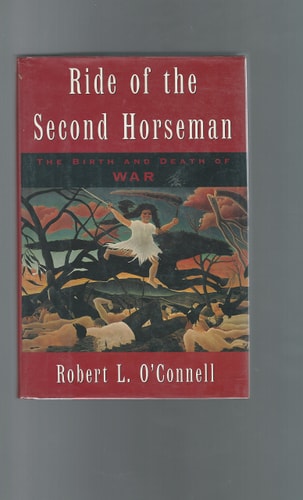
Ride of the Second Horseman: The Birth and Death of War
0
0
As an Amazon Associate and affiliate partner, Menrva Books earns from qualifying purchases. Learn more
Author Description
Accurst be he that first invented war," wrote Christopher Marlowe--a declaration that most of us would take as a literary, not literal, construction. But in this sweeping overview of the rise of civilization, Robert O'Connell finds that war is indeed an invention--an institution that arose due to very specific historical circumstances, an institution that now verges on extinction.In Ride of the Second Horseman, O'Connell probes the distant human past to show how and why war arose. He begins with a definition that distinguishes between war and mere feuding: war involves group rather than individual issues, political or economic goals, and direction by some governmental structure, carried out with the intention of lasting results. With this definition, he finds that ants are the only other creatures that conduct it--battling other colonies for territory and slaves. But ants, unlike humans, are driven by their genes; in humans, changes in our culture and subsistence patterns, not our genetic hardware, brought the rise of organized warfare. O'Connell draws on anthropology and archeology to locate the rise of war sometime after the human transition from nomadic hunting and gathering to agriculture, when society split between farmers and pastoralists. Around 5500 BC, these pastoralists initiated the birth of war with raids on Middle Eastern agricultural settlements. The farmers responded by ringing their villages with walls, setting off a process of further social development, intensified combat, and ultimately the rise of complex urban societies dependent upon warfare to help stabilize what amounted to highly volatile population structures, beset by frequent bouts of famine and epidemic disease. In times of overpopulation, the armies either conquered new lands or self-destructed, leaving fewer mouths to feed. In times of underpopulation, slaves were taken to provide labor. O'Connell explores the histories of the civilizations of ancient Sumeria, Egypt, Assyria, China, a
Menrva's Summary
THE THESIS
Robert L. O'Connell investigates the origins of organized warfare, arguing that it is a cultural invention rather than an inherent biological trait. Drawing on extensive research in anthropology and archaeology, O'Connell posits that war emerged as a specific institutional response to the transition from nomadic lifestyles to settled agriculture. He examines how early societal structures utilized warfare as a mechanism for population control and resource management, ultimately suggesting that this institution may eventually reach a point of obsolescence.
THE SCOPE MAP
What You Will Find
- Analysis of the transition from nomadic hunting and gathering to sedentary agricultural societies.
- A comparative study of human warfare versus the territorial conflicts observed in ant colonies.
- Examination of ancient civilizations including Sumeria, Egypt, Assyria, and China.
- Theoretical framework linking population volatility, famine, and disease to the necessity of organized combat.
THE AUTHORITY PERSPECTIVE
Scholars and readers frequently note the ambitious scope of O'Connell's historical synthesis, which bridges the gap between evolutionary biology and political history. Experts highlight this as a provocative text that challenges conventional assumptions regarding the inevitability of human conflict.
Page Count:
320
Publication Date:
1995-09-21
Publisher:
Oxford University Press
ISBN-10:
0195064607
ISBN-13:
9780195064605
History
Archaeology
Sociology
War
Warfare
Anthropology
Community Tags
Similar Books