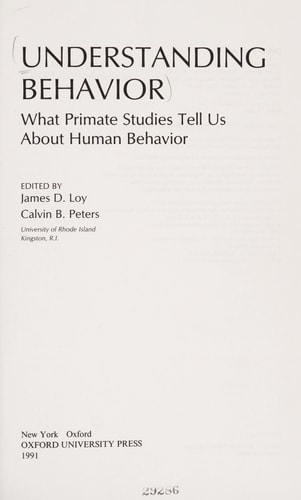
Understanding Behavior: What Primate Studies Tell Us about Human Behavior
0
0
As an Amazon Associate and affiliate partner, Menrva Books earns from qualifying purchases. Learn more
Author Description
Scientific studies of monkeys, apes, and other nonhuman primates began just over 50 years ago. Since then tens of thousands of hours of observation have been made on these animals in the wild and in captivity. The chief rationale for scientific primatology has always been the belief that mportant insights into human behavior and society could be gained through studies of our evolutionary kin. This book reviews what we have learned. Distinguished researchers outline primatological insights in six areas: sex, parenting, behavioral development, aggression/dominance, culture and kinship. The chapters show how primates have been used as simplified models of human behaviors and how they have contributed to scenarios of human evolution. Lay readers, students, and specialists alike will find this a readable and useful compendium of the findings of scientific primatology.
Menrva's Summary
THE THESIS
This book investigates the core question of what fifty years of scientific primatology reveals about the evolutionary origins and mechanisms of human social behavior. Authors Calvin B. Peters and James D. Loy compile research from distinguished primatologists to evaluate how observations of nonhuman primates serve as models for understanding human development. By synthesizing decades of fieldwork and captive studies, the text provides a framework for interpreting human evolution through the lens of our closest biological relatives.
THE SCOPE MAP
What You Will Find
- Analysis of six primary behavioral domains: sex, parenting, development, aggression, dominance, and culture.
- Examination of the methodological shift from field observation to captive behavioral modeling.
- Synthesis of evolutionary scenarios linking primate social structures to human societal patterns.
- Comparative data sets derived from fifty years of longitudinal primate research.
THE AUTHORITY PERSPECTIVE
Experts and students alike recognize this work as a comprehensive and accessible compendium of primatological findings. Readers frequently note that the text successfully bridges the gap between specialized scientific research and general interest in human evolutionary biology.
Page Count:
280
Publication Date:
1991-02-28
Publisher:
Oxford University Press
ISBN-10:
0195060202
ISBN-13:
9780195060201
Science
Psychology
Sociology
Primatology
Anthropology
Evolutionary Biology
Psychology Comparative
Community Tags
Similar Books