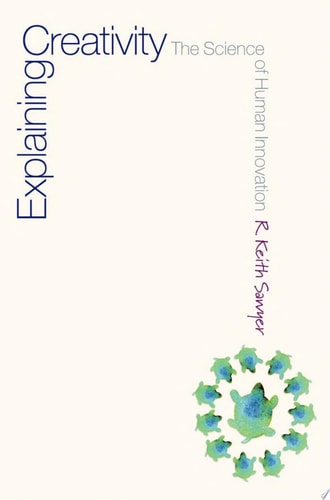
Explaining Creativity: The Science of Human Innovation
0
0
As an Amazon Associate and affiliate partner, Menrva Books earns from qualifying purchases. Learn more
Author Description
In the last 50 years, psychologists, anthropologists, and sociologists have increasingly turned to studying creativity, so we now know more about it than ever before. However, until about a decade ago, creativity researchers focused only on highly valued activities, such as creating masterpieces in art and making highly significant discoveries in science. In Explaining Creativity, R. Keith Sawyer extends the study of creativity by examining not only these endeavors, but also movies, music videos, cartoons, video games, hypertext fiction, stage performance, business innovation, and advances in computer technology.Sawyer uses the sociocultural approach to creativity that was pioneered by Howard Becker, Mihaly Csikszentmihalyi, and Howard Gardner, allowing him to move beyond the individual to consider the social process. Taking into account the interdisciplinary nature of creativity, Sawyer integrates psychological data with anthropological research on creativity in non-Western cultures and sociological studies on the situations, contexts, and networks of creative activity. For more information, see www.explainingcreativity.com.
Menrva's Summary
THE THESIS
How does the sociocultural framework redefine our understanding of human creativity beyond the traditional focus on individual genius? R. Keith Sawyer, a prominent researcher in the psychology of creativity, synthesizes decades of interdisciplinary data to argue that innovation is a social process rather than an isolated cognitive event. By integrating psychological experiments with anthropological observations and sociological network theory, the author constructs a comprehensive model that accounts for the contexts and collaborative environments where creative acts occur.
THE SCOPE MAP
What You Will Find
- A sociocultural methodology pioneered by scholars such as Howard Becker and Mihaly Csikszentmihalyi.
- Comparative analysis of creative practices across Western and non-Western cultures.
- Examination of diverse creative domains including video games, business innovation, and digital media.
- Synthesis of sociological network theory and psychological cognitive data.
THE AUTHORITY PERSPECTIVE
Experts frequently cite this work as a foundational text for understanding the shift from individual-centric to system-based creativity research. Readers often note the academic density of the prose, which serves as a comprehensive resource for students and professionals in the social sciences.
Page Count:
368
Publication Date:
2006-01-19
Publisher:
Oxford University Press
ISBN-10:
0195161645
ISBN-13:
9780195161649
Psychology
Science
Innovation
Creativity
Anthropology
Creative ability
Sociology