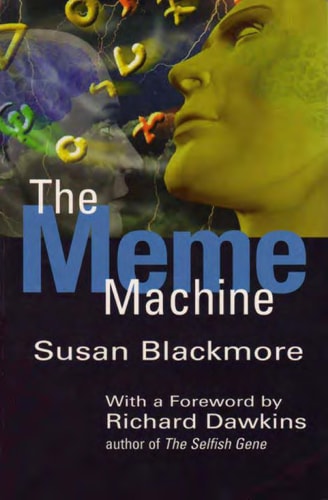
The Meme Machine
0
0
As an Amazon Associate and affiliate partner, Menrva Books earns from qualifying purchases. Learn more
Author Description
What is a meme? First coined by Richard Dawkins in The Selfish Gene, a meme is any idea, behavior, or skill that can be transferred from one person to another by imitation: stories, fashions, inventions, recipes, songs, ways of plowing a field or throwing a baseball or making a sculpture. The meme is also one of the most important--and controversial--concepts to emerge since The Origin of the Species appeared nearly 150 years ago.In The Meme Machine Susan Blackmore boldly asserts: "Just as the design of our bodies can be understood only in terms of natural selection, so the design of our minds can be understood only in terms of memetic selection." Indeed, Blackmore shows that once our distant ancestors acquired the crucial ability to imitate, a second kind of natural selection began, a survival of the fittest amongst competing ideas and behaviors. Ideas and behaviors that proved most adaptive--making tools, for example, or using language--survived and flourished, replicating themselves in as many minds as possible. These memes then passed themselves on from generation to generation by helping to ensure that the genes of those who acquired them also survived and reproduced. Applying this theory to many aspects of human life, Blackmore offers brilliant explanations for why we live in cities, why we talk so much, why we can't stop thinking, why we behave altruistically, how we choose our mates, and much more.With controversial implications for our religious beliefs, our free will, our very sense of "self," The Meme Machine offers a provocative theory everyone will soon be talking about.
Menrva's Summary
THE THESIS
The book investigates whether the evolution of the human mind can be explained through the lens of memetic selection, mirroring the biological process of natural selection. Susan Blackmore, a psychologist and writer, utilizes evolutionary theory and the concept of the meme—originally coined by Richard Dawkins—to argue that human culture and behavior are driven by the replication of ideas. She posits that once humans developed the capacity for imitation, a second evolutionary process began, where ideas compete for survival within the human mind.
THE SCOPE MAP
What You Will Find
- The application of Darwinian principles to cultural transmission and imitation.
- Analysis of human behaviors including altruism, language, and mate selection.
- Theoretical exploration of the concept of the self and free will in a memetic framework.
Scope Limits
- The text does not provide a comprehensive history of all cultural developments.
- It does not offer empirical neurological data to support the physical existence of memes as biological structures.
THE AUTHORITY PERSPECTIVE
Experts and readers frequently note that this text serves as a foundational, albeit provocative, introduction to the field of memetics. While some critics debate the scientific rigor of applying biological selection to abstract ideas, the book remains a widely cited reference for those interested in evolutionary psychology.
Page Count:
288
Publication Date:
2000-05-16
Publisher:
Oxford University Press
ISBN-10:
019286212X
ISBN-13:
9780192862129
Psychology
Popular Science
Earth Sciences
Imitation
Anthropology
Sociobiology
Behavior evolution
Memetics
Evolutionary Biology
Community Tags
Other Editions(3)
Similar Books






Reader Comments
Share Your Thoughts
No comments yet. Be the first to share your thoughts!