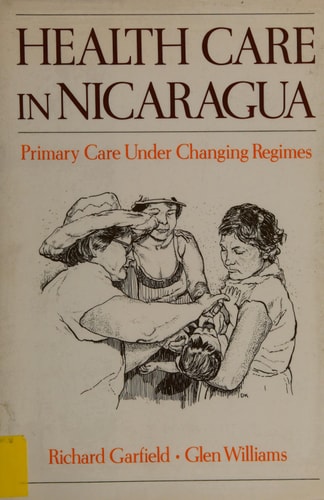
Health Care in Nicaragua: Primary Care Under Changing Regimes
0
0
As an Amazon Associate and affiliate partner, Menrva Books earns from qualifying purchases. Learn more
Author Description
Despite two decades of natural disasters, political upheaval, and economic decline, Nicaragua has maintained a system of health care that responds to the needs of most of its people. This important work accurately describes the twists and turns in Nicaragua's health policy during the last two decades. The authors, an epidemiologist and a health educator, have taken part in that system for twelve years, and bring a wealth of data and experience to this unique survey. They draw on detailed comparisons with other countries to examine attempts to promote community participation, harness international assistance, manage the private sector, and develop public services under changing political regimes. The health system under the Somoza dictatorship, the Sandinista revolution, and the post-Sandinista chamorro government is scrutinized in light of several key issues. These include the decisions to focus on primary care or hospitals; to limit or expand the roles for volunteers; to provide care to the entire population or only priority groups; to rely mainly on public or private services; and whether to depend on central government or local control. No other book depicts a developing country's health system with as much analytical detail or with as extensive documentation. Yet this work simultaneously remains an account of the patients, community organizers, health workers, and political leaders. It is a thought provoking case study of people, programs, and policies in international health.
Menrva's Summary
THE THESIS
This book investigates how Nicaragua maintained a functional primary health care system despite enduring decades of natural disasters, economic instability, and radical political transitions. The authors, Richard Garfield and Glen Williams, utilize their combined expertise as an epidemiologist and a health educator to provide a longitudinal analysis of the nation's health policy. By drawing on twelve years of direct involvement and extensive comparative data, they evaluate how different regimes—from the Somoza dictatorship to the Sandinista revolution and the Chamorro government—shaped the delivery of medical services and the management of public versus private resources.
THE SCOPE MAP
What You Will Find
- Comparative analysis of health policy across three distinct political regimes in Nicaragua.
- Evaluation of the tension between centralized government control and decentralized local management.
- Examination of the strategic shift between prioritizing primary care services versus hospital-based infrastructure.
- Assessment of the role of community participation and volunteer labor in sustaining health outcomes.
THE AUTHORITY PERSPECTIVE
Experts recognize this work as a foundational case study for understanding the complexities of health systems in developing nations. Readers frequently note the depth of the documentation and the authors' ability to balance high-level policy analysis with the lived experiences of patients and health workers.
Page Count:
320
Publication Date:
1992-05-14
Publisher:
Oxford University Press
ISBN-10:
0195067533
ISBN-13:
9780195067538
History
Public Health
Nicaragua
Health Care
Community Tags
Similar Books