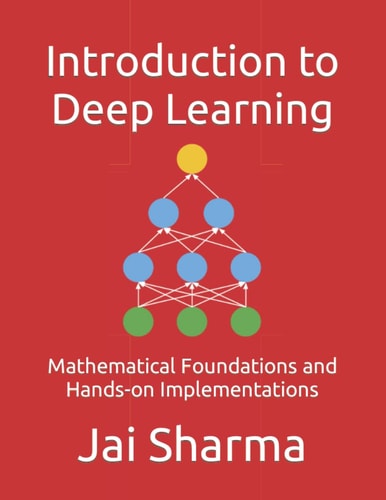
Introduction to Deep Learning: Mathematical Foundations and Hands-on Implementations
0
0
As an Amazon Associate and affiliate partner, Menrva Books earns from qualifying purchases. Learn more
Author Description
Deep Learning is one of the greatest areas of research and practical applications today; it is a gold mine waiting to be tapped into. I am really proud of you for taking your first step to learning about this great subject by reading this text. In this text, we will start by exploring the applications of Deep Learning and why it has become so widespread in its use. We will then examine some elementary Machine Learning algorithms such as Linear Regression and Logistic Regression, both of which will give us a nice foundation to learn about Neural Networks. Next, we will explore Neural Networks at a high level without going too much into the mathematical side. After this high level approach, we delve into the basic mathematical understanding needed for Deep Learning, including Linear Algebra and Calculus. We develop the tools we will need to derive the parameter updates for Linear Regression, Logistic Regression, and Neural Networks. These derivations are a essential to explaining how Machine Learning and Deep Learning algorithms “learn” from patterns. The second part of the text focuses on implementing the skills in the first part in code. We will be using Python here because of its famous libraries such as NumPy and Matplotlib. We will conclude the text with implementations of Linear Regression, Logistic Regression, and Neural Networks from scratch in Python. I hope this book will not only provide instruction on the concepts behind Deep Learning, but also the interest to ex- plore its riches. Thank you for reading this text.
Menrva's Summary
THE THESIS
This book investigates the fundamental mathematical principles and practical implementation techniques of Deep Learning. The author, Jai Bhagwan Sharma, aims to guide readers from basic Machine Learning concepts to advanced Neural Networks, emphasizing the mathematical underpinnings required for understanding how these algorithms learn. The text covers essential topics like Linear Algebra and Calculus, demonstrating their application in deriving parameter updates for various models, and then transitions to hands-on coding implementations using Python.
THE SCOPE MAP
- Exploration of Deep Learning applications and widespread adoption.
- Introduction to elementary Machine Learning algorithms: Linear Regression and Logistic Regression.
- High-level overview of Neural Networks.
- In-depth mathematical foundations including Linear Algebra and Calculus.
- Derivation of parameter updates for Linear Regression, Logistic Regression, and Neural Networks.
- Hands-on implementation of concepts using Python and libraries like NumPy and Matplotlib.
- Implementation of Linear Regression, Logistic Regression, and Neural Networks from scratch in Python.
THE AUTHORITY PERSPECTIVE
The book is presented as a comprehensive guide for beginners entering the field of Deep Learning, starting with foundational concepts and progressing to practical coding implementations. The author's approach emphasizes a strong mathematical basis, which is crucial for a deep understanding of how machine learning models learn from data. The inclusion of Python code examples using popular libraries aims to provide readers with the practical skills needed to apply these concepts.
Page Count:
100
Publication Date:
2021-11-14
Publisher:
Independently published
ISBN-13:
9798767404476
Non-Fiction
Science
Computer Science
Mathematics
Machine Learning
Python Programming
Community Tags
Similar Books