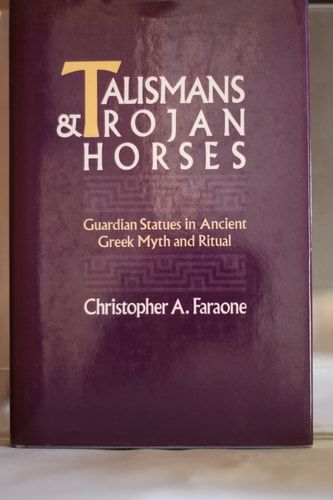
Talismans and Trojan Horses: Guardian Statues in Ancient Greek Myth and Ritual
0
0
As an Amazon Associate and affiliate partner, Menrva Books earns from qualifying purchases. Learn more
Author Description
References abound in Greek legends and historical accounts to special statues or images upon whose presence the continued safety or livelihood of a city or house depended. These images include statues of predatory beasts or destructive insects, plague gods, dangerous goddesses, and the like. Faraone describes the variety and range of these images and uses them to provide new interpretations of early Greek myths about Pandora, the Trojan Horse, and the living statues created by Hephaestus. He sets the Greek evidence in a wider eastern-Mediterranean context by detailed discussions of similar Near Eastern and Egyptian practices, and closes with a re-evaluation of the traditional scholarly approach to religious art as purely representational.
Menrva's Summary
THE THESIS
This work investigates the function and cultural significance of apotropaic statues in ancient Greek society, questioning whether these objects were merely representational art or active, protective agents. Christopher A. Faraone, a scholar of ancient Greek religion and magic, utilizes a combination of literary evidence, historical accounts, and comparative archaeology to argue that these statues served as functional talismans. By situating Greek practices within the broader context of the eastern Mediterranean, he challenges the traditional academic view that religious art in antiquity was primarily aesthetic or symbolic in nature.
THE SCOPE MAP
What You Will Find
- Analysis of protective statues representing predatory beasts, insects, and plague deities.
- Comparative study of Near Eastern and Egyptian religious practices regarding talismanic objects.
- Re-interpretations of foundational myths including Pandora, the Trojan Horse, and the automata of Hephaestus.
- A critical framework for evaluating the functional, non-representational role of religious art in antiquity.
THE AUTHORITY PERSPECTIVE
Scholars and classicists frequently cite this text as a foundational study for understanding the intersection of magic and material culture in the ancient world. Readers often note the academic density of the prose, which provides a rigorous examination of both primary sources and cross-cultural archaeological evidence.
Page Count:
208
Publication Date:
1992-08-13
Publisher:
Oxford University Press
ISBN-10:
0195064046
ISBN-13:
9780195064049
History
Religion
Mythology
Archaeology
Omens
Ancient Greece
Art History
Community Tags
Similar Books