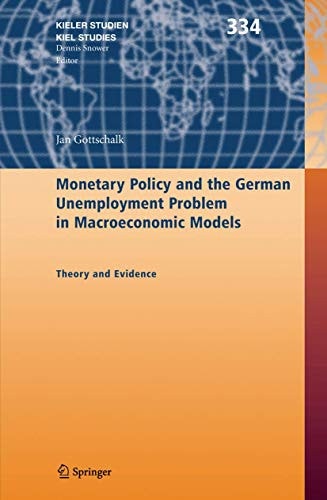
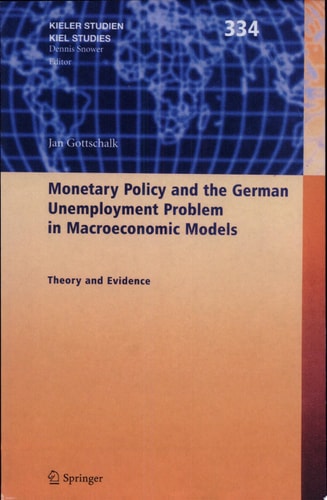
Monetary Policy and the German Unemployment Problem in Macroeconomic Models: Theory and Evidence
0
0
As an Amazon Associate and affiliate partner, Menrva Books earns from qualifying purchases. Learn more
Author Description
Having the high unemployment in Germany in mind, this book discusses how macroeconomic theory has evolved over the past forty years. It shows that in recent years a convergence has taken place, with modern models embodying a Keynesian transmission mechanism, monetarist policy implication, and modeling techniques inspired by new classical economics and real business cycle theory. It also probes in which direction models may be extended from here. Empirically, the book uses different econometric techniques to investigate the relevance and implications of different macroeconomic theories for German data. A key question this book investigates is the role of demand and supply side conditions for the increase in the German unemployment rate. On a policy level, the book relates the implications of the different theories to the ongoing debate on the appropriate roles of demand and supply side policies for curing the German unemployment problem.
Menrva's Summary
THE THESIS
This book investigates the evolution of macroeconomic theory and its application to Germany's persistent unemployment problem over the past four decades. It details how modern models have integrated elements from Keynesian, monetarist, new classical, and real business cycle theories, and explores potential future extensions. The work empirically analyzes German economic data using various econometric techniques to assess the relevance of these different theoretical frameworks. A central focus is determining the relative contributions of demand-side and supply-side factors to the rise in German unemployment, and relating these findings to policy debates on appropriate interventions.
THE SCOPE MAP
- Evolution of macroeconomic theory over 40 years
- Integration of Keynesian, monetarist, new classical, and real business cycle elements in modern models
- Empirical investigation of German unemployment using different econometric techniques
- Analysis of the role of demand and supply side conditions in German unemployment
- Policy implications for demand and supply side interventions
THE AUTHORITY PERSPECTIVE
The book offers a comprehensive analysis of macroeconomic theories as they relate to German unemployment, utilizing empirical evidence and econometric methods. It aims to bridge theoretical advancements with practical policy considerations, examining the interplay of demand and supply factors. The work is structured to provide insights into the historical development of economic thought on this issue and its contemporary relevance for policy-making in Germany. Its focus on both theoretical models and empirical data suggests a rigorous approach to understanding a complex economic challenge.
Page Count:
288
Publication Date:
2011-04-09
Publisher:
Springer Berlin Heidelberg
ISBN-10:
364206504X
ISBN-13:
9783642065040
Non-Fiction
Economics
Econometrics
Unemployment
German Economy
Community Tags
Other Editions(2)
Similar Books