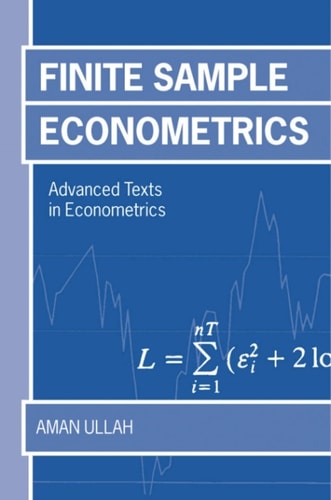
Finite Sample Econometrics
0
0
As an Amazon Associate and affiliate partner, Menrva Books earns from qualifying purchases. Learn more
Author Description
This book provides a comprehensive and unified treatment of finite sample statistics and econometrics, a field that has evolved in the last five decades. Within this framework, this is the first book which discusses the basic analytical tools of finite sample econometrics, and explores their applications to models covered in a first year graduate course in econometrics, including repression functions, dynamic models, forecasting, simultaneous equations models, panel data models, and censored models. Both linear and nonlinear models, as well as models with normal and non-normal errors, are studied. Finite sample results are extremely useful for applied researchers doing proper econometric analysis with small or moderately large sample data. Finite sample econometrics also provides the results for very large (asymptotic) samples. This book provides simple and intuitive presentations of difficult concepts, unified and heuristic developments of methods, and applications to various econometric models. It provides a new perspective on teaching and research in econometrics, statistics, and other applied subjects.
Menrva's Summary
THE THESIS
This text investigates the analytical tools and methodologies required for finite sample statistics and econometrics, addressing the limitations of asymptotic theory in small or moderately sized datasets. Aman Ullah, a recognized scholar in the field, synthesizes five decades of research to provide a unified framework for analyzing both linear and nonlinear models. The book serves as a pedagogical resource for graduate-level study, bridging the gap between theoretical statistical results and their practical application in economic modeling.
THE SCOPE MAP
What You Will Find
- Analytical tools for finite sample econometrics
- Coverage of regression functions, dynamic models, and forecasting
- Methodologies for simultaneous equations, panel data, and censored models
- Comparative analysis of normal and non-normal error distributions
Scope Limits
- Does not focus on introductory undergraduate-level statistics
- Does not provide exhaustive computational code for software implementation
THE AUTHORITY PERSPECTIVE
Experts identify this work as a foundational text for graduate students and researchers who require rigorous methods for small-sample data analysis. Readers frequently note the technical density of the prose, which is balanced by the author's attempt to provide intuitive explanations for complex econometric concepts.
Page Count:
240
Publication Date:
2004-01-01
Publisher:
OUP Oxford
ISBN-10:
0191525057
ISBN-13:
9780191525056
Economics
Academic
Mathematics
Econometrics
Reference
Statistics
Community Tags
Other Editions(3)


Similar Books