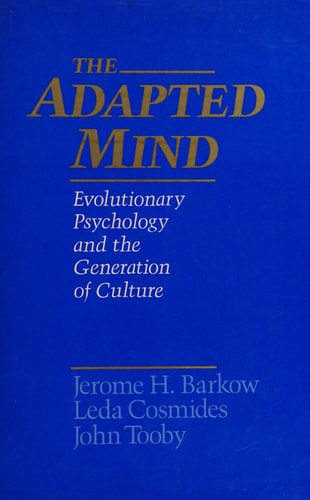
The Adapted Mind: Evolutionary Psychology and the Generation of Culture
0
0
As an Amazon Associate and affiliate partner, Menrva Books earns from qualifying purchases. Learn more
Author Description
Although researchers have long been aware that the species-typical architecture of the human mind is the product of our evolutionary history, it has only been in the last three decades that advances in such fields as evolutionary biology, cognitive psychology, and paleoanthropology have made the fact of our evolution illuminating. Converging findings from a variety of disciplines are leading to the emergence of a fundamentally new view of the human mind, and with it a new framework for the behavioral and social sciences. First, with the advent of the cognitive revolution, human nature can finally be defined precisely as the set of universal, species-typical information-processing programs that operate beneath the surface of expressed cultural variability. Second, this collection of cognitive programs evolved in the Pleistocene to solve the adaptive problems regularly faced by our hunter-gatherer ancestors--problems such as mate selection, language acquisition, cooperation, and sexual infidelity. Consequently, the traditional view of the mind as a general-purpose computer, tabula rasa, or passive recipient of culture is being replaced by the view that the mind resembles an intricate network of functionally specialized computers, each of which imposes contentful structure on human mental organization and culture. The Adapted Mind explores this new approach--evolutionary psychology--and its implications for a new view of culture.
Menrva's Summary
THE THESIS
This work investigates how the species-typical architecture of the human mind functions as a product of evolutionary history rather than a general-purpose learning mechanism. The authors, Jerome H. Barkow, John Tooby, and Leda Cosmides, synthesize research from cognitive psychology, biology, and paleoanthropology to argue that the mind consists of specialized information-processing programs. They propose that these programs evolved during the Pleistocene to address specific adaptive challenges faced by hunter-gatherer ancestors, thereby providing a new foundational framework for the behavioral and social sciences.
THE SCOPE MAP
What You Will Find
- Analysis of the cognitive revolution and its impact on defining human nature.
- Examination of specific adaptive problems including mate selection, language acquisition, and cooperation.
- Theoretical framework replacing the tabula rasa model with a modular, functionally specialized view of the mind.
- Integration of cross-disciplinary data to explain the relationship between biological evolution and cultural variability.
THE AUTHORITY PERSPECTIVE
Experts recognize this text as a foundational document in the establishment of evolutionary psychology as a distinct academic discipline. Readers frequently note the academic density of the prose, which serves as a rigorous introduction to the field's core theoretical tenets.
Page Count:
688
Publication Date:
1992-08-06
Publisher:
Oxford University Press
ISBN-10:
0195060237
ISBN-13:
9780195060232
Psychology
Science
Anthropology
Sociobiology
Evolutionary Psychology
Evolutionary Biology
Cognition and culture
Community Tags
Similar Books