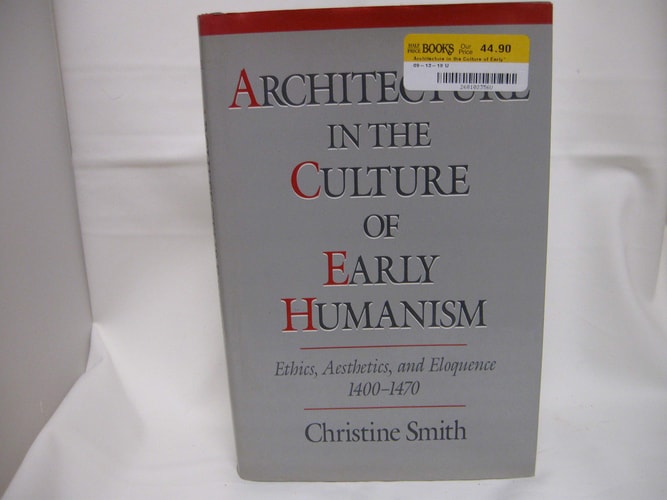
Architecture in the Culture of Early Humanism: Ethics, Aesthetics, and Eloquence, 1400-1470
0
0
As an Amazon Associate and affiliate partner, Menrva Books earns from qualifying purchases. Learn more
Author Description
The impact of early Italian humanism on the development of Quattrocentro architecture has received much attention in recent years. In these essays, Smith focuses instead on the place of architecture in humanist thought--on the ways that works of architecture or architectural imagery became important vehicles for the expression of the humanist's ethical, political, and cultural concerns. The essays in the first part focus on the thought of Leon Battista Alberti and his circle, covering topics ranging from Alberti's use of architectural imagery as allegory for the ideal moral state of spiritual tranquillity to how the rhetorical, philosophical, and theological ideal of varietas influenced the design of Pienza. In the second part, the emphasis shifts to the impact of Byzantine scholarship on Quattrocento humanists' attitudes toward architecture.
Menrva's Summary
THE THESIS
This work investigates how architecture functioned as a primary vehicle for expressing the ethical, political, and cultural values of early Italian humanists between 1400 and 1470. Christine Smith, an expert in Renaissance studies, examines the intersection of architectural design and humanist intellectual life. By analyzing both physical structures and architectural imagery, the author argues that buildings were not merely functional spaces but were deeply embedded in the rhetorical and philosophical discourse of the Quattrocento.
THE SCOPE MAP
What You Will Find
- Analysis of Leon Battista Alberti’s architectural theories and his circle.
- Examination of the concept of varietas as applied to the design of Pienza.
- Exploration of Byzantine scholarship and its influence on humanist architectural attitudes.
- Discussion of architectural imagery as an allegory for moral and spiritual states.
THE AUTHORITY PERSPECTIVE
Scholars frequently cite this text as a significant contribution to the understanding of the intellectual history behind Renaissance building practices. The prose is noted for its academic rigor and its ability to bridge the gap between architectural history and humanist philosophy.
Page Count:
320
Publication Date:
1992-06-04
Publisher:
Oxford University Press
ISBN-10:
0195061284
ISBN-13:
9780195061284
Architecture
Philosophy
History
Art History
Humanism
Renaissance
Community Tags
Similar Books