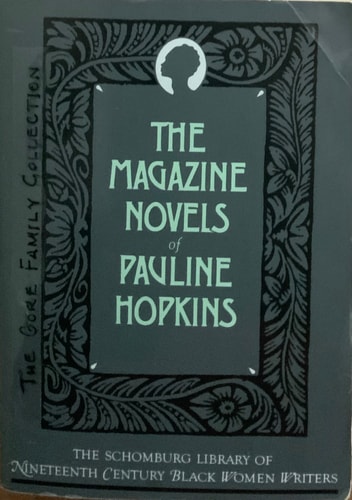
The Magazine Novels of Pauline Hopkins: Including Hagar's Daughter, Winona, and Of One Blood
0
0
As an Amazon Associate and affiliate partner, Menrva Books earns from qualifying purchases. Learn more
Author Description
First published in May 1900, the Colored American Magazine provided a pioneering forum for black literary talent previously stifled by lack of encouragement and opportunity. Not only a prolific writer for the journal, Pauline Hopkins also served as one of its powerful editorial forces. This volume of her magazine novels, which appeared serially in the journal between March 1901 and November 1903, reveals Hopkins' commitment to fiction as a vehicle for social change. She weaves important political themes into the narrative formulas of nineteenth-century dime-store novels and story papers, which emphasize suspense, action, complex plotting, multiple and false identities, and the use of disguise. Offering both instruction and entertainment, Hopkins' novels also expose the limitations of popular American narrative forms when telling the stories of black characters.
Menrva's Summary
THE PULSE
Pauline Hopkins utilizes the serialized magazine format to challenge the racial constraints of nineteenth-century American literature through suspenseful, politically charged narratives. The protagonist figures in these novels navigate complex social hierarchies and systemic oppression, often relying on shifting identities and disguises to survive or seek justice. Hopkins employs a narrative framework that blends the conventions of popular dime-store fiction with urgent social commentary. Her work systematically deconstructs the limitations of contemporary storytelling by centering the experiences of black characters within high-stakes, action-oriented plots.
INSIDE THE PAGES
- Utilization of serialized narrative structures common to early twentieth-century periodicals
- Integration of political themes regarding race, identity, and social justice
- Employment of suspense-driven plot devices such as false identities and elaborate disguises
- Subversion of nineteenth-century dime-store novel tropes
- Exploration of the intersection between entertainment and didactic social instruction
- Focus on the agency of black characters within restrictive societal frameworks
- Complex, multi-layered plotting characteristic of the era's story papers
- Critique of the limitations inherent in popular American narrative forms of the time
THE COLLECTIVE ECHO
Discussion often centers on Hopkins' ability to balance the demands of popular serial fiction with a rigorous commitment to social advocacy. Readers frequently highlight the tension between the fast-paced, melodramatic elements of her plots and the underlying political critiques that define her work. Critics often note that these novels serve as a vital record of the intellectual and literary climate of the early twentieth-century black press. The effectiveness of her world-building is frequently debated in relation to how she adapts existing genre conventions to better represent the realities of her characters. These narratives remain a significant subject of study for those interested in the evolution of African American literary traditions.
Page Count:
672
Publication Date:
1990-07-12
Publisher:
Oxford University Press
ISBN-10:
0195063252
ISBN-13:
9780195063257
Fiction
Historical
Social Issues
African American
classic