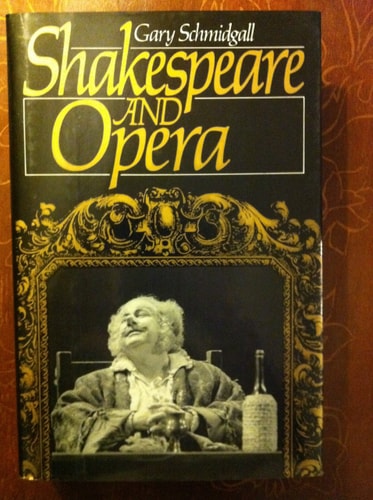
Shakespeare and Opera
0
0
As an Amazon Associate and affiliate partner, Menrva Books earns from qualifying purchases. Learn more
Author Description
If opera had existed in Elizabethan London, the world's Top Bard, as W.H. Auden called him, might have become the world's Top Librettist. As Gary Schmidgall shows in this illuminating study, Shakespeare's expressive ways and dramaturgical means are like those of composers and librettists in numerous and often astonishing ways. No wonder that well over two hundred operas have been based on Shakespeare's plays.Ranging widely through the Shakespearean canon and the standard operatic repertory, Schmidgall presents a fascinating comparison, focusing on similarities of expressive style, scenic structure, staging, and performance practice. Shakespeare and Opera offers extended discussions of issues central to both theatrical genres, including their shared demand for virtuoso display, the comparable functions of set speeches and arias, and the similarities of verbal and musical rhetoric, and the charges of unreality and melodrama that have dogged them both. In addition, Schmidgall provides concise essays on the most intriguing Shakespeare-based operas, including works of Verdi, Wagner, Bellini, Rossini, Berlioz, Thomas, Vaughan Williams, Barber, and Britten. He enriches his argument with the insights of the great composers who never set Shakespeare (Mozart, Puccini, and Strauss among them), major observers of the legitimate stage (from Samuel Johnson to Eric Bentley) and the musical stage (from Joseph Addison to Joseph Kerman), as well as the incisive views of influential artists, critics, and performers as diverse as Walt Whitman, H.L. Mencken, and Laurence Olivier.For all who love the stage, Shakespeare and Opera offers endless insight and fascination. Schmidgall's extended comparison of the two dramaturgies provides a fresh perspective on Shakespeare, musical theater, comparative drama, and theater history.
Menrva's Summary
THE THESIS
This study investigates the structural and aesthetic parallels between the dramatic works of William Shakespeare and the conventions of operatic composition. Gary Schmidgall, a scholar of theater and music, utilizes a comparative framework to analyze how Shakespearean dramaturgy aligns with the requirements of the musical stage. By examining the rhetorical devices, performance practices, and narrative structures common to both, the author argues that Shakespeare’s plays possess an inherent operatic quality that has facilitated their frequent adaptation by composers throughout history.
THE SCOPE MAP
What You Will Find
- Comparative analysis of scenic structure, staging, and performance practice in Elizabethan drama and opera.
- Examination of shared rhetorical devices, such as the function of set speeches versus operatic arias.
- Case studies of Shakespearean adaptations by composers including Verdi, Wagner, Bellini, and Britten.
- Synthesis of critical perspectives from historical observers, composers, and performers regarding the intersection of text and music.
THE AUTHORITY PERSPECTIVE
Scholars and musicologists frequently cite this work as a comprehensive resource for understanding the historical and technical intersections between the legitimate stage and the opera house. The text is noted for its interdisciplinary approach, serving as a bridge for readers interested in both literary analysis and music history.
Page Count:
416
Publication Date:
1990-12-06
Publisher:
Oxford University Press
ISBN-10:
019506450X
ISBN-13:
9780195064506
Music
Shakespeare
Theater
Literary Criticism
Criticism history
Opera