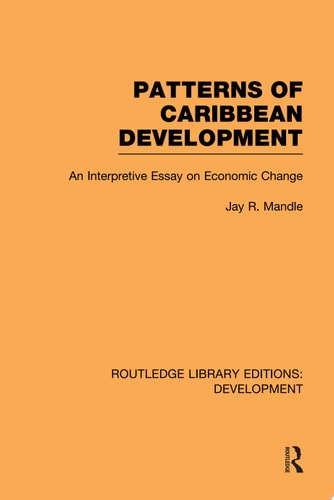
Patterns of Caribbean Development: An Interpretive Essay on Economic Change
0
0
As an Amazon Associate and affiliate partner, Menrva Books earns from qualifying purchases. Learn more
Author Description
First published in 1982, this study attempts to put contemporary Caribbean development into historical perspective. By first constructing a Marxist framework for the study of development, Jay Mandle assesses the reasons why the region emerged underdeveloped and evaluates post-world-war two efforts to overcome the legacy of poverty through a strategy of "industrialization through invitation." Identifying the reasons why a Marxist framework yielded results which were unsatisfactory, the author then explores the requirements which must be met for a more reliable study of the Caribbean’s economic development. Case studies of Cuba, Jamaica, Guyana, Trinidad and Tobago examine the extent to which these requirements have been met.
Menrva's Summary
THE THESIS
This study investigates the historical roots and persistent challenges of economic underdevelopment in the Caribbean. Jay Mandle, drawing on his expertise in economic history, constructs a Marxist framework to analyze the region's emergence from underdevelopment. The book critically evaluates post-World War II strategies, particularly 'industrialization by invitation,' and identifies the limitations of a purely Marxist approach for understanding these complex dynamics. It then outlines the necessary conditions for a more robust analysis of Caribbean economic development, supported by case studies.
THE SCOPE MAP
- A Marxist framework applied to the study of development.
- Analysis of the historical reasons for Caribbean underdevelopment.
- Evaluation of post-WWII 'industrialization by invitation' strategies.
- Examination of the limitations of Marxist analysis in this context.
- Requirements for a more reliable study of Caribbean economic development.
- Case studies of Cuba, Jamaica, Guyana, Trinidad and Tobago.
THE AUTHORITY PERSPECTIVE
This interpretive essay is recognized for its rigorous application of Marxist theory to understand the historical trajectory of Caribbean economic development. The author's critical assessment of post-war industrialization strategies, particularly 'industrialization by invitation,' provides a nuanced perspective on the region's persistent underdevelopment. By examining case studies of key Caribbean nations, the book offers insights into the requirements for more effective economic analysis. The work is valued for its historical depth and its contribution to the discourse on development economics in the region.
Page Count:
176
Publication Date:
2010-11-26
Publisher:
Routledge
ISBN-10:
1136877606
ISBN-13:
9781136877605
Economics
Non-Fiction
History
Marxist Theory
Economic History
Caribbean Studies